

Renting & Buying a Home in Italy
❓ 1. General information
📌 Renting (affitto / locazione) — an official contract between the landlord and the tenant for temporary use of a dwelling for a fee.
📌 Purchase (acquisto) — acquisition of property ownership through a notarial deed (rogito notarile) with registration in the land registry (catasto).
2. Legal framework
- Codice Civile (Arts. 1571–1614) — rental.
- Legge 431/1998 — regulates rental contracts (4+4, 3+2, transitorio).
- D.Lgs. 23/2011 — the “cedolare secca” regime.
- Codice Civile (Arts. 1470–1500) + Legge 47/1985 — property purchase.
- T.U. Immigrazione (D.Lgs. 286/1998, art. 7) — dichiarazione di ospitalità (for living without a contract).
🔍 3. Where to look for housing in Italy
🖥 Online platforms:
- immobiliare.it, idealista.it, casa.it, subito.it — the most popular.
- Bakeca.it, Facebook Marketplace, Telegram groups — many cheaper private listings.
📍 Offline:
- notices in bars, universities, bus stops;
- agenzie immobiliari (real estate agencies);
- churches, charities, comune.
📄 4. Types of rental contracts in Italy
The legal basis is Legge 431/1998, which clearly defines rental formats. The choice of contract type affects:
- length of stay,
- the possibility to obtain residenza and documents (permesso, school),
- rent amount,
- the landlord’s tax regime.
🏠 A. Contratto 4+4 (canone libero)
Key features:
- Term: 4 years + automatic renewal for another 4 (unless either party objects).
- Price: freely set between the parties (market rate).
- Use: suitable for residenza, school registration, applying for permesso di soggiorno, tessera sanitaria.
Early termination by the tenant:
- Allowed in the presence of gravi motivi (serious reasons: job loss, relocation, illness).
- Written notice required 6 months in advance (raccomandata A/R or PEC).
Pros:
- Maximum stability for the tenant.
- Used to legalize residence (residenza).
Cons:
- Usually more expensive than 3+2.
- Long term: not always ideal if you plan a shorter stay.
🏠 B. Contratto 3+2 (canone concordato)
Key features:
- Term: 3 years + automatic renewal for 2.
- Price: set according to municipal schedules (accordi territoriali) negotiated between tenants’ unions and owners’ associations.
- The rate is usually 20–30% lower than the market.
Tax benefits:
- For the landlord: lower IRPEF, IMU, sometimes a flat cedolare secca rate (10%).
- For the tenant: lower rent, stability.
Pros:
- Win-win: tenant pays less; owner pays lower taxes.
- Accepted by all authorities for residenza and documentation.
Cons:
- Not available everywhere (check whether there is an accordo territoriale in your comune).
- Some owners refuse 3+2 due to the lower price (negotiation may be needed).
🏠 C. Contratto transitorio (temporary)
Key features:
- Term: from 1 to 18 months.
- Used for temporary situations: short-term work, internships, study, relocation.
- Justification is mandatory (e.g., copia contratto di lavoro a termine).
Pros:
- Legal rental even for a short term.
- Convenient for students, seasonal workers, interns.
Cons:
- Cannot be renewed automatically.
- Not suitable for residenza (the comune often refuses due to the temporary nature).
- The price may even be higher due to the short term.
🏠 Cedolare secca (landlord’s tax regime)
This is not a separate contract but a tax regime the owner can apply.
Key features:
- Rate: 21% (standard contracts) or 10% (often with canone concordato 3+2, depending on the region).
- The landlord pays taxes at a flat rate, without IRPEF.
- While cedolare secca is in force:
- ❌ rent cannot be increased (ISTAT),
- ❌ the tenant cannot be charged additional tax costs.
Pros for the tenant:
- Protection: the price does not increase during the contract term.
- Transparent payments.
Cons:
- The owner may opt out of this regime upon renewal.
- Not automatic: the landlord decides.
📑 5. Documents for renting housing in Italy
To sign a contratto di locazione, the tenant must provide the owner or the agency with a set of documents. While formal requirements vary, in most Italian cities you will be asked for:
- Identity document
- Passport
- Carta d’identità (if already available).
- Codice Fiscale
Mandatory for any contract.- Without Codice Fiscale the contract cannot be registered with Agenzia delle Entrate.
- It is used for all official documents (payments, taxes, cauzione, utilities).
👉 Therefore, even if you do not yet have a permesso di soggiorno, obtain Codice Fiscale before searching for housing.
- Permesso di soggiorno
- Not always required (depends on the owner).
- In large cities (Rome, Milan, Bologna), landlords or agencies almost always request the permesso di soggiorno or at least the ricevuta postale (submission receipt).
- In smaller cities and private rentals, sometimes a passport and codice fiscale suffice.
- Proof of sufficient income (prova di reddito)
Owners want to be sure you can pay the rent. Commonly requested:- Busta paga (pay slip),
- Contratto di lavoro (employment contract, even fixed-term),
- INPS certification (e.g., social benefits or pension confirmation),
- For students — university certificate + parental financial guarantee,
- For freelancers — Partita IVA + ultima dichiarazione dei redditi.
- Contact details
- Phone number, email.
- Sometimes a domicilio address (even temporary).
- Cauzione (security deposit)
- Standard: 1–3 months’ rent.
- Held by the owner until the contract ends.
- Returned after apartment inspection (repair costs may be deducted).
- Other possible requirements
- Codice IBAN (to set up automatic rent payments — RID/SDD),
- Guarantor (especially in Milan, Rome, Florence): another person with official income in Italy who undertakes to pay in case of arrears,
- Fideiussione bancaria (bank guarantee): common for expensive rentals or when the tenant lacks steady income.
- Registration of the contract
The law requires the rental contract to be registered with Agenzia delle Entrate within 30 days from signing.- Registration is usually done by the landlord (can also be via CAF/accountant).
- Cost: 2% of annual rent (split 50/50 between the parties) unless the cedolare secca regime is chosen.
- After registration, the tenant receives a copy stamped by Agenzia delle Entrate — necessary for residenza, iscrizione scolastica, permesso di soggiorno.
🧾 6. How to buy property in Italy
1) Who can buy property
- EU citizens — no restrictions.
- Non-EU citizens (extra-UE) — subject to the principle of reciprocity.
- Holders of permesso di soggiorno UE per soggiornanti di lungo periodo (former “carta di soggiorno”) — like EU residents, no restrictions.
- Other types of permesso (work, family, study, temporary protection, etc.) do not prohibit purchase; the difficulty is usually in getting a mortgage (banks often require stable income in Italy).
What is the “principle of reciprocity” (condizione di reciprocità)
In Italy, a foreigner can exercise certain civil rights (including buying real estate) if Italian citizens have the same right in the foreigner’s country. In other words: “you can here if ours can in your country.” This stems from Art. 16 of the preliminary provisions to the Civil Code and notarial practice.
Important exceptions/clarifications from the Italian MFA (MAECI):
- EU/EEA citizens — buy without reciprocity.
- Non-EU but legally residing in Italy with carta di soggiorno or a valid permesso (work, self-employment, family, humanitarian, study) — admitted to civil rights; in practice reciprocity is not an obstacle to purchase.
If you do not reside in Italy (non resident) and you are from a non-EU country — reciprocity is checked for your country in the MAECI database.
How to check reciprocity for your country (quick guide)
- Open the MAECI page → “Condizioni di reciprocità” → Elenco Paesi.
- Find your country; it states whether its citizens can buy real estate in Italy (sometimes with limits such as agricultural land, border/coastal areas, etc.).
- If needed, the notary will perform an official check (standard due diligence before the rogito).
2) Stages of a sale-purchase transaction
Step 1. Preliminary property checks (due diligence) — do this before any deposits:
- Ownership and origin (atto di provenienza) — how the seller acquired the property (purchase, inheritance, donation).
- Visura catastale and planimetria catastale — land registry extract and plan.
- Conformità urbanistica/edilizia — compliance of the actual state with prior permits (permesso di costruire, DIA/SCIA, condono).
- Agibilità/abitabilità (habitability; not always mandatory, but desirable).
- Mortgages/liens/easements — checked by the notary; if there is a bank mortgage on the seller, agree on payoff/cancellation on rogito day.
- Condominium status — ask for liberatoria confirming no arrears, minutes of meetings, major planned works (facades, lift, etc.).
- APE (Attestato di Prestazione Energetica) — energy certificate (mandatory).
- Tenants/rental contract — if rented, check terms and duration.
- Utility/tax arrears (IMU, TARI) — ensure none outstanding.
Step 2. Offer to purchase (proposta d’acquisto)
- Written offer with price, validity term, and conditions; often accompanied by a small deposit (assegno/bonifico).
- If the seller signs, both are obliged to move to the preliminare (compromesso).
Step 3. Preliminary agreement (compromesso / preliminare di vendita)
- Fixes the price, payment schedule, rogito date, delivery conditions, list of furniture/appliances (if any), and conditions precedent (condizioni sospensive), e.g., mortgage approval, removal of abuses.
- Caparra confirmatoria (deposit) usually 10–20% — protects the parties: the breaching party loses the deposit (or returns double).
- Register the preliminare with Agenzia delle Entrate within 20 days (usually via agency/notary):
- fixed fee €200;
- 0.5% on the caparra;
- 3% on acconti prezzo if not subject to VAT (when the seller is a private individual).
- Keep receipts for all payments.
Step 4. Mortgage (mutuo), if needed
- Documents: income (busta paga/tax return), credit history, permesso, codice fiscale, property file.
- Costs:
- bank fee (istruttoria) ~ €700–1,500+;
- appraisal (perizia) ~ €250–400;
- imposta sostitutiva: 0.25% (if “prima casa”) or 2% (otherwise).
- LTV often limited to 70–80%; for non-EU without long-term income, stricter terms.
- The bank provides Piano di ammortamento and rate type: fisso, variabile, or misto.
Step 5. Notarial deed (rogito notarile)
- The notary is a neutral party who checks title and legal soundness; the buyer usually chooses the notary.
- Payment often via assegni circolari (bank drafts) or notary escrow (conto dedicato).
- At the rogito the seller hands over keys (unless agreed otherwise); the buyer becomes owner upon signing.
- The notary registers and records (trascrizione) in the Registry (Conservatoria) within ~20 days.
3) Taxes and costs when buying
Option A: Buying from a private seller
- Prima casa (concessionary “first home”): imposta di registro 2% of the cadastral value (valore catastale, “prezzo-valore”), plus €50 mortgage + €50 cadastral fees.
- Not prima casa: imposta di registro 9% (minimum €1,000), + €50 + €50.
Option B: Buying from a company/developer
- If the sale is with VAT (often new builds, or within 5 years of construction):
- IVA: 4% (prima casa), 10% (standard), 22% (A/1, A/8, A/9 — “luxury”),
- fixed registration fees: €200 (registro) + €200 (ipotecaria) + €200 (catastale).
- If the sale is without VAT (rarer) — same as private.
Other costs
- Notary: ~ €1,500–4,000+ (depends on price, documents, mortgage, city).
- Agency: 2–3% + IVA (paid by buyer/by agreement).
- Translator/interpreter (if needed): €100–300+.
- Home/mortgage insurance — per bank conditions.
4) “Prima casa” tax regime
🏡 “Prima Casa” tax benefits in Italy
Regulated by Nota II-bis all’art. 1 Tariffa, Parte I, DPR 131/1986 (Testo Unico Registro) and clarified by numerous Agenzia delle Entrate circulars.
Eligibility (all 4 key conditions):
- Property category
- Must not be luxury (abitazioni di lusso):
- A/1, A/8, A/9.
- ✅ All other residential categories allowed (A/2, A/3, A/4, A/5, A/6, A/7, A/11).
- Must not be luxury (abitazioni di lusso):
- Residenza
- At purchase: the property is located in the comune where the buyer has residenza;
- If not yet: the buyer undertakes to transfer residenza to that comune within 18 months from rogito (declared in the notarial deed).
- Special simplifications for certain public employees (military, police, transferred civil servants).
- No other “suitable” home in the same comune
- You cannot own another habitable residential property in that comune (i.e., not a ruin or a storage).
- Allowed: garage (C/6), cellar (C/2), storage (C/3), etc.
- No prior purchase with “prima casa” benefits
- You must not own another dwelling purchased with prima casa anywhere in Italy.
- Exception: if you sell the previous prima casa before or within 1 year after buying the new one, you can use the benefit again.
What benefits does “Prima casa” provide
A. Buying from a private seller
- Imposta di registro: 2% (instead of 9%), min €1,000.
- Imposta ipotecaria: €50 (fixed).
- Imposta catastale: €50 (fixed).
- Tax base: cadastral value (rendita catastale × coefficient), usually below market price.
B. Buying from a developer (with VAT)
- IVA: 4% (instead of 10% or 22%).
- Imposta di registro: €200 (fixed).
- Imposta ipotecaria: €200 (fixed).
- Imposta catastale: €200 (fixed).
C. Mortgage tax (mutuo)
- Imposta sostitutiva sul mutuo: 0.25% (instead of 2%).
Loss of benefits and sanctions — you lose the benefit if:
- You do not transfer residenza to the property’s comune within 18 months.
- It turns out you had another habitable home in that comune.
- You owned another prima casa and did not sell it in time.
- You sell within 5 years and do not buy another prima casa within 1 year.
Consequences:
- You must pay the difference up to the standard rate (9% or 10–22% with IVA),
- penalty: 30% of unpaid tax,
- legal interest (interessi legali).
5) Particularities when buying from a developer
- All advance payments before rogito must be backed by fideiussione bancaria/assicurativa (bank/insurance guarantee in case of insolvency) — D.Lgs. 122/2005.
- After completion — polizza decennale postuma (10-year insurance against structural defects).
- Contract should state detrazione IVA and the commissioning timeline.
6) After purchase: what to do
- Voltura utenze — transfer electricity/gas/water/internet.
- Inform the amministratore condominio (to receive notices/bills).
- Register residenza (if prima casa) in ANPR/Comune within 18 months.
- Notify Agenzia delle Entrate/Comune for TARI (waste) and IMU (if second home).
- Keep all assegni/bonifici, copies of deeds, APE, plan, guarantees.
7) Taxes after purchase and on sale
- IMU:
- not due on prima casa (except A/1, A/8, A/9);
- due on second homes at the comune rate.
- TARI: due for all property users.
- Capital gains tax (plusvalenza):
- on sale within 5 years — 26%, unless it was your main residence for most of the time;
- you can opt for imposta sostitutiva 26% directly in the notarial deed.
8) Typical risks and how to avoid them
- Plan mismatch (planimetria ≠ actual state) → seller must guarantee conformità; otherwise demand rectification before rogito or a price reduction + a clause.
- Mortgage/lien → notary arranges contestuale cancellazione (same-day cancellation).
- Condominium debts → demand liberatoria from the administrator.
- “Black” deposits without a contract → pay only with written confirmation and registration.
- Unreliable intermediaries → work with registered agencies (REA number/Camera di Commercio registration).
9) Minimal document set for the buyer
- Passport/ID + codice fiscale.
- If needed — translator at rogito.
- Family status data (to define property regime: comunione/separazione).
- For mortgage — income/tax returns/contracts, permesso.
💶 7. Mortgage (mutuo) for migrants in Italy
Who can get a mutuo (generally) — Italian banks (Intesa Sanpaolo, UniCredit, Banco BPM, BNL, BPER, etc.) do not formally discriminate against foreigners, but require:
- Permesso di soggiorno
- Usually a long-term one (UE per soggiornanti di lungo periodo) or a permesso lasting longer than the mutuo term.
- With a temporary permesso (e.g., protezione temporanea, seasonal work), a mutuo is almost impossible.
- Stable income
- Contratto a tempo indeterminato (open-ended employment) — best case.
- Contratto a tempo determinato — possible, but you must show a long track record and regularity.
- Partita IVA — accepted if there are at least 2–3 years of income history (dichiarazione redditi).
- Tax residence in Italy
- You must be a fiscal resident (have codice fiscale, file dichiarazione dei redditi, pay taxes in Italy).
Typical documents requested by the bank
For the borrower
- Passport + codice fiscale.
- Permesso di soggiorno (valid, ideally long-term).
- Certificato di residenza (if already available).
- Busta paga (last 2–3), CUD or contratto di lavoro.
- For self-employed (Partita IVA): dichiarazione redditi (Modello Redditi PF or 730) for last 2–3 years.
For the property
- Visura catastale.
- Planimetria catastale.
- Atto di provenienza (how the seller acquired it).
- APE (energy certificate).
- Liberatoria condominiale (no condominium debt).
- For developer purchases — garanzia fideiussoria and polizza decennale postuma.
Mortgage conditions
- Loan amount: usually up to 70–80% of property value (LTV). For migrants, banks sometimes cap at 60–70%.
- Term: 10–30 years (20–25 standard).
- Rate type: tasso fisso, variabile, misto.
- Borrower’s age: mutuo typically ends by age 75.
- Monthly payment: not more than 30–35% of your net income.
Additional mutuo costs
- Spese di istruttoria: €500–1,500.
- Perizia: €250–400.
- Imposta sostitutiva:
- 0.25% of the loan (if prima casa),
- 2% (if not).
- Mandatory insurance (fire/catastrophes) — one-off or annual.
- Optional insurances (life, unemployment) — often pushed, but not mandatory.
📎 8. Useful links
- Agenzia delle Entrate (оренда, податки): https://www.agenziaentrate.gov.it
- Ministero dell’Economia e delle Finanze: https://www.mef.gov.it
- Banca d’Italia (іпотека, mutui): https://www.bancaditalia.it
- Immobiliare.it (пошук житла): https://www.immobiliare.it
- Idealista: https://www.idealista.it
- Tecnocasa: https://www.tecnocasa.it
Frequently Asked Questions (FAQ)
- Can a foreigner without Italian citizenship buy a home?
Yes. EU citizens — without restrictions. For extra-UE, the condizione di reciprocità applies. If you legally live in Italy with a permesso, there are practically no obstacles.
- Is a permesso di soggiorno mandatory to buy?
For registering ownership — no, a passport and codice fiscale suffice. But for a mutuo (mortgage), banks usually require a valid permesso.
- What is “prima casa” and what benefits does it provide?
A concessionary regime for first homes: taxes are reduced (registro 2% or IVA 4%, instead of 9–22%). Conditions: residenza in the property’s comune within 18 months, no other suitable property in that comune, and no previous prima casa.
- Can I buy without residenza in Italy?
Yes, but it will be a seconda casa → higher taxes (registro 9% or IVA 10–22%), and you will pay IMU annually.
- What are the stages of purchase?
- Proposta d’acquisto (offer).
- Preliminare/compromesso (contract with 10–20% deposit).
- Mutuo (if needed).
- Rogito notarile (signing with the notary, key handover).
- Registration of the deed at Agenzia delle Entrate and Catasto.
- What taxes does the buyer pay?
- Privato → privato: registro 2% (prima casa) or 9% (seconda), + €50 + €50.
- Developer (con IVA): IVA 4% / 10% / 22%, + €200 each.
- Plus notary, agency, other costs.
- Can a migrant get a mutuo?
Yes, if there is stable income (indeterminato contract or Partita IVA with history), permesso, and tax residence. Banks finance 60–80% of value.
- Is a translator required?
Yes, if you do not sufficiently speak Italian. At the rogito the notary may require a sworn translator for legal correctness.
- What are the most common risks when buying?
- Planimetria not matching reality,
- mortgages/liens,
- condominium debts,
- “black” deposits without a registered preliminare.
Solution: always conduct due diligence via a notary.
- What to do after purchase?
- Voltura utenze (electricity, gas, water, internet),
- inform amministratore condominio,
- register residenza (for prima casa),
- file TARI with the comune,
- pay IMU (if a second home),
- arrange home insurance.
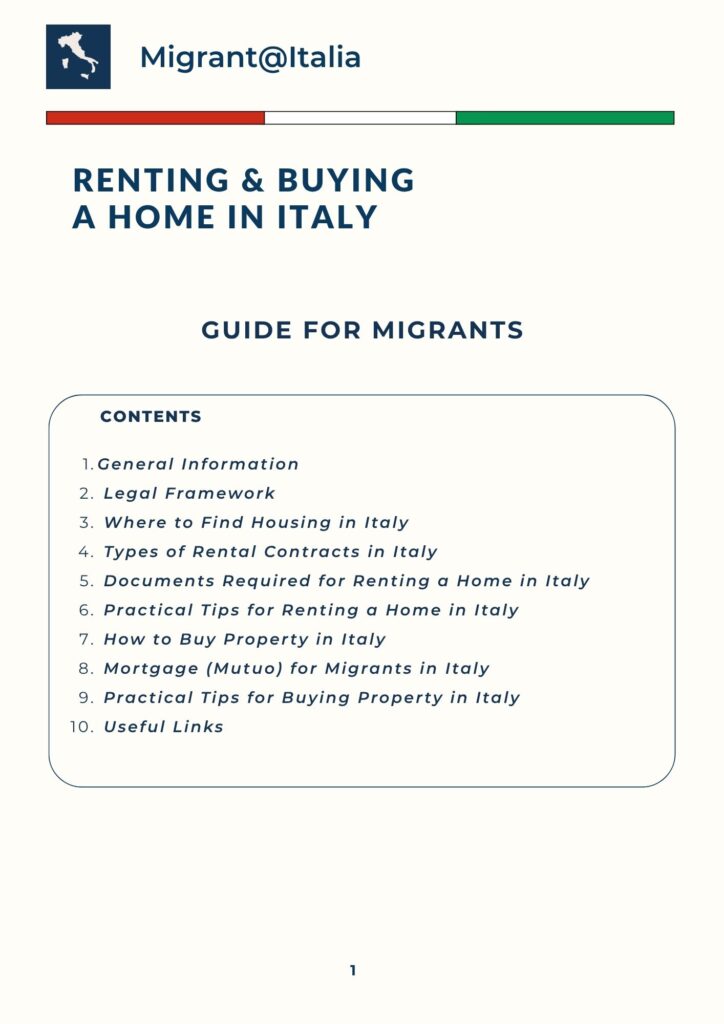
We’ve prepared a detailed PDF Guide for you — covering all the steps and procedures for Renting and Buying a Home in Italy.
Download and use it as a ready-to-go manual!