

Employment in Italy
What is a “contratto di lavoro”?
A contratto di lavoro is an official written agreement between an employee and an employer that governs working conditions, pay, and the rights of both parties.
📌 1. Legal framework:
- Codice Civile (arts. 2094–2134)
- D.Lgs. 81/2015 (Jobs Act – contract types)
- Statuto dei Lavoratori (Law 300/1970)
- CCNL (Contratti Collettivi Nazionali di Lavoro) — collective agreements that regulate conditions in different sectors.
- Costituzione Italiana, arts. 36–40 — guarantees on pay, rest, and unions.
📘 2. Main types of employment contracts in Italy
- Contratto a tempo indeterminato (open-ended contract)
- Contratto a tempo determinato (fixed-term contract)
- Contratto di apprendistato (apprenticeship/training with salary)
- Contratto a chiamata (on-call/intermittent work)
- Contratto stagionale (seasonal contract)
- Tirocinio / Stage (internship/traineeship)
1. Contratto a tempo indeterminato (open-ended contract)
What it is: An employment agreement with no end date. Work continues until either party terminates it in accordance with the law/CCNL.
- Who it suits: Anyone seeking stability, creditworthiness, and long-term residence.
- Why it’s better than fixed-term: Highest protection against dismissal, full package of social guarantees, easier to obtain a mortgage, rent housing, get a carta di soggiorno UE (clear contributions history).
2) What must be in the contract
- Parties’ details, job title/inquadramento (CCNL level; e.g., “IV livello – CCNL Commercio”).
- RAL (reddito annuo lordo) or monthly rate + reference to CCNL pay tables.
- Work schedule: full-/part-time, night/holiday work, breaks.
- Periodo di prova (probation): duration, conditions.
- Leave (ferie), extra hours/allowances, ROL/permessi (time-off hours).
- Reference to the CCNL: this defines half your rights.
- Termination conditions (preavviso/grounds/procedure).
- Any specific conditions: smart working, reperibilità, patto di non concorrenza, patto di prova, trasferte/diarie.
3) Probation period (Periodo di prova)
- Set by the CCNL and job level.
- Typical: 2–6 months (longer for skilled roles, shorter for unskilled).
- During probation, either party may terminate without cause and without severance, but with written notice.
- Days actually worked count; long illnesses/maternity often “pause” probation.
4) Working time, breaks, overtime
- Standard: 40 hours/week (or less — per CCNL).
- Break after 6 hours — minimum 10 minutes (CCNL often grants 30–60 min).
- Straordinari (overtime):
- Paid with a premium (commonly +15–30% weekdays, +30–50% holidays/night) per CCNL.
- May be compensated by riposi compensativi.
- Night, holiday, Sunday work — separate additional rates.
- Part-time indeterminato: allowed; any clausole elastiche (schedule flexibility) must be in the contract with extra pay.
5) Salary and payments
- Busta paga monthly: base + allowances − taxes (IRPEF) − INPS → Netto.
- Tredicesima (13th month) — almost always; quattordicesima (14th) — in some CCNLs.
- Welfare aziendale / buoni pasto — common in large companies.
- Scatti di anzianità (seniority increments) — in many CCNLs every 2–3 years.
- Superminimo — an individual top-up (ask to state clearly assorbibile/non assorbibile).
- Travel/diem — typically rimborso spese + diaria (clearly set in the contract/company policy).
Rule of thumb: Netto ≈ 65–75% of Lordo (depends on family detrazioni, regional/municipal surcharges).
6) Leave, sick pay, family events
- Ferie — minimum 4 weeks/year (CCNL often 26 days).
- ROL/Permessi — additional time off; varies by CCNL.
- Malattia — from day 4 paid by INPS/employer (scheme and % per CCNL). Certificato medico telematico is mandatory.
- Infortunio sul lavoro — covered by INAIL (pay from the day of injury + medical care).
- Maternità/Paternità:
- Mother: 5 months of mandatory paid leave (2 before and 3 after birth, or 1 before and 4 after). Pay: 80% of average salary (INPS; sometimes company tops up).
- Father: 10 days of mandatory paid leave within the first 5 months after birth.
- Congedo parentale (parental leave): up to 6 months for each parent (30% pay), can be used intermittently.
- Assenze giustificate: marriage, bereavement, blood donation, court — defined by CCNL.
7) Pension and social contributions (INPS), insurance (INAIL)
- Employer pays INPS (pension, NASpI, sick pay, etc.).
- INAIL — protection against workplace injuries/occupational diseases.
- All contributions appear on the busta paga and in your INPS personal area (Estratto Conto Contributivo).
8) TFR (Trattamento di Fine Rapporto)
- “Severance” that accrues monthly (≈ 6.91% of the annual wage bill).
- Paid upon termination/retirement/transfer.
- Can be directed to a pension fund (Fondo pensione) — with your consent.
9) Smart working / Reperibilità / Non concorrenza
- Smart working — only by agreement: separate accordo + security policy/tools/compensation.
- Reperibilità (on-call standby) — only with extra pay (CCNL or individual agreement).
- Patto di non concorrenza — must be limited in time, geography, and activities, and include MANDATORY compensation; otherwise invalid.
10) Termination: dismissal/resignation
Employer side
- Giusta causa (serious misconduct): dismissal without notice.
- Giustificato motivo soggettivo (breach of duties) / oggettivo (economic/organizational reasons) — with preavviso.
- Procedure: letter of contestazione, opportunity to defend, then decision.
- Tutele crescenti regime (D.Lgs. 23/2015): compensation depends on seniority (2–18 months’ pay), reintegra only in narrow cases (discrimination, insussistenza del fatto, etc.).
Employee side (dimissioni)
- Only online via Ministero del Lavoro portal (Dimissioni Telematiche) with SPID/CIE or through Patronato.
- Must work preavviso (length — in CCNL) or compensate the employer.
- Dimissioni per giusta causa (wages not paid, mobbing, worsening conditions) — without preavviso; contact a union/ITL.
After involontaria disoccupazione (dismissal by employer or dimissioni per giusta causa) you can apply for NASpI at INPS (within 68 days; duration ≈ half of contributions in the last 4 years; payment reduced by 3%/month after the 6th month).
11) Taxes and certificates
- Each year the employer issues CU (Certificazione Unica) — needed for Modello 730 or PF.
- Possible detrazioni: for children/rent/health/transport/education (depending on that year’s law).
- For foreigners: having tempo indeterminato often facilitates ricongiungimento familiare, permesso UE di lungo periodo, and mortgages.
2. Contratto a tempo determinato (fixed-term contract)
1) Essence and main difference
- What it is: an employment contract with a clearly defined end date.
- Main difference vs indeterminato: in a fixed-term contract the parties know from the start when it ends, even if both are satisfied. To continue, a new agreement is needed.
- Used for temporary needs: replacing staff on leave/maternity, seasonal peaks (tourism, agriculture), time-limited projects.
Legal basis:
- D.Lgs. 81/2015 (Jobs Act), especially arts. 19–29.
- Legge 96/2018 (“Decreto Dignità”) — limits on fixed-term contracts to reduce abuse.
- CCNL — defines details (e.g., allowances, preavviso for early termination).
2) Duration and limits
- Max duration of a single contract: 12 months without justification.
- Can be extended up to 24 months, but only with reasons defined by law or CCNL:
- temporary need for work;
- replacement of another employee;
- seasonal activity.
- Proroghe (extensions): no more than 4 within the same 24 months.
- After reaching 24 months, the employer must either convert to indeterminato or end the relationship.
3) Contract conditions
The contract must state:
- Start and end dates;
- RAL (pay) according to CCNL;
- Periodo di prova (as in indeterminato, usually shorter);
- Schedule, ferie, permessi, malattia — same as indeterminato;
- Reference to the relevant CCNL;
- Possibility of extension and its conditions.
4) Salary and payments
- Same rights as indeterminato:
- monthly busta paga;
- Tredicesima (and, if applicable, 14th);
- supplements for night/holiday/overtime;
- TFR accrues.
- Note: fixed-term contracts often include a superminimo (temporary top-up) to attract workers, which ends when the contract ends.
5) Leave, sick pay, social guarantees
- Ferie: same 4 weeks/year (pro-rata to contract length).
- Malattia: paid by INPS from day 4.
- Maternità/paternità: same rights as indeterminato (INPS + employer).
- INPS/INAIL: contributions accrue identically.
- NASpI: entitlement to unemployment benefits after a fixed-term ends (if enough contributions were paid).
6) Termination and end
- Contract ends automatically on the set date. Preavviso not required.
- Early termination:
- Employee may resign for giusta causa (wages not paid, mobbing, etc.).
- Employer — only for giusta causa (serious breach).
- If the employer keeps using the employee after expiry → the contract automatically becomes indeterminato.
7) Pros and cons (vs indeterminato)
✅ Pros
- Easier to get hired (lower risk for employer).
- Grants the same guarantees (INPS, ferie, malattia, TFR).
- Experience for the CV + contributions count for permesso.
- Possible transition to indeterminato after several fixed-terms.
❌ Cons
- Instability: end date known from day one.
- Harder life planning: landlords, banks often refuse without indeterminato.
- Limited time → some employers abuse by rolling one fixed-term into another.
- Harder to obtain permesso UE di lungo periodo or a mortgage.
👩🎓 3. Contratto di apprendistato (training/apprenticeship with salary)
1) Essence and purpose
- An employment contract that combines work + professional training.
- Goal: build a qualification or professional profile.
- The worker receives a salary, but lower than a “fully qualified” employee in the same role, since the employer invests in training.
- The contract always includes an individual training plan (piano formativo individuale), approved by the Region/CCNL.
📌 Important: This is not an unpaid internship (like stage/tirocinio), but a real contract with INPS, INAIL, TFR, ferie.
2) Legal basis
- D.Lgs. 81/2015 (Jobs Act, Capo V: Apprendistato)
- Sector CCNLs (define duration, pay levels, training conditions).
- Regioni are responsible for training programs and qualification certification.
3) Types of apprendistato
- Apprendistato per la qualifica e il diploma professionale (I livello)
- For youth aged 15–25.
- Combines school/courses + work.
- Used in crafts and technical fields.
- Apprendistato professionalizzante (II livello)
- Most common.
- Age: 18–29 (17 if already qualified).
- Grants a professional profile recognized by the CCNL.
- Duration: 3 years (sometimes 5 in crafts).
- Apprendistato di alta formazione e ricerca (III livello)
- For universities, PhDs, research centers.
- Combines higher education with an employment contract.
4) Duration
- Minimum: 6 months.
- Maximum: usually 3 years, up to 5 in some sectors.
- Probation: as in other contracts, often shorter.
5) Pay and contributions
- Pay is lower than for a fully qualified employee:
- Year 1: ≈ 60% of the CCNL rate.
- Year 2: ≈ 70–80%.
- Year 3: ≈ 90%.
- All INPS/INAIL contributions are paid.
- Includes TFR, ferie, malattia, maternità.
👉 This is not unpaid practice: there is always salary, even if lower.
6) Worker’s rights
- Ferie — minimum 4 weeks/year.
- Malattia — as in determinato/indeterminato.
- INPS: pension contributions accrue.
- INAIL: injury insurance.
- Training: right to time off for courses.
- At the end, the worker may receive a qualification certificate.
7) End of contract
- If the employer does not wish to continue — it ends on the agreed date.
- If all goes well → it automatically becomes contratto a tempo indeterminato.
- For early termination, rules are the same as determinato.
8) Pros and cons
✅ Pros
- Enables young people/beginners to enter the labor market.
- Full contract (INPS, INAIL, TFR).
- Can convert to indeterminato.
- Training + salary simultaneously.
❌ Cons
- Lower pay.
- Time-limited (generally not possible after age 30, barring rare exceptions).
- Some employers abuse it: hire only apprendisti to pay less and avoid conversion.
📞 4. Contratto a chiamata (lavoro intermittente, “on-call” work)
1) Essence and characteristics
- An employment form where the worker works only when called by the employer.
- Used in sectors with irregular needs: hotels, restaurants, events, logistics, holidays/tourism.
- The worker has the same rights as under other contracts (insurance, INPS, INAIL), but the work is occasional.
📌 Difference from determinato: determinato has a fixed term; chiamata has no stable schedule, only calls.
2) Legal basis
- D.Lgs. 81/2015, arts. 13–18.
- May be concluded in writing. If “without written confirmation” → it is deemed indeterminato.
- Also governed by CCNLs (many sectors have specific provisions on lavoro intermittente).
3) When it can be used
- By age:
- under 24 (but work must end before the 25th birthday);
- from 55 years old.
- By type of activity:
- in sectors defined by law or CCNL (horeca, tourism, seasonal services).
- Used only for occasional, irregular tasks.
4) Employer’s obligations
- Before each call, the employer must notify INPS/INAIL (telematically or by SMS) no later than the day before.
- If not done and the worker works → fines and risk of the contract being deemed indeterminato.
5) Pay and benefits
- Pay only for hours/days actually worked.
- Minimum rates set by CCNL.
- Two options:
- Senza indennità di disponibilità (no availability allowance): the worker is not obliged to always be available and is not paid if not called.
- Con indennità di disponibilità (with availability pay): the worker must respond to calls even if no work is assigned; the employer pays a fixed monthly allowance.
6) Social guarantees
- The worker accrues ferie, TFR, malattia, and INPS/INAIL contributions proportional to hours worked.
- Right to NASpI if enough contributions have been accumulated.
- If there is an indennità di disponibilità, this also counts toward contributions.
7) Pros and cons
✅ Pros
- Flexibility: convenient for students, people with a second job, retirees.
- Opportunity to gain official contributions (INPS/INAIL).
- Suitable as first experience for migrants in tourism or restaurants.
❌ Cons
- No stability: unknown how many hours will actually be offered.
- Income varies widely.
- Frequent abuse: calls without prior INPS notification.
- Hard to get housing/credit/permesso UE lungo periodo (insufficient stable income).
🌾 5. Contratto stagionale (seasonal contract)
1) Essence and characteristics
- A form of tempo determinato used for work that is seasonal by nature.
- Used in sectors where labor demand arises only at certain times of year: agriculture, tourism, hotels, restaurants, winemaking, harvesting, resort services.
- Has the same rights as determinato, but with special rules on duration, extension, and interruption.
📌 For non-EU foreigners, seasonal contracts are often governed by Decreto Flussi quotas.
2) Legal basis
- D.Lgs. 81/2015 (Jobs Act) – governs determinato/indeterminato.
- Codice Civile, arts. 2094–2134.
- Decreto Flussi – annual government decree with quotas for non-EU seasonal workers.
- CCNL Agricoltura, Turismo, Commercio – collective agreements detailing rates and conditions.
3) Duration and limits
- The contract always has an end date, but it can be extended within the season.
- Maximum duration usually 6–9 months (sometimes up to 12, depending on sector and CCNL).
- A worker may have several seasonal contracts with different employers in the same year.
4) Specifics for foreigners (Decreto Flussi)
- Non-EU citizens may enter Italy specifically with a permesso di soggiorno per lavoro stagionale.
- Permesso is issued for the contract term (up to 9 months).
- After several years of seasonal work (minimum 2 consecutive years) you can apply for a permesso pluriennale per lavoro stagionale (multi-year permit).
- In certain cases (if provided by law) a seasonal contract may be converted to tempo determinato or indeterminato, enabling a longer permesso.
5) Pay and payments
- Set by sector CCNLs (e.g., CCNL Agricoltura or Turismo).
- The worker has the same rights as determinato:
- monthly busta paga;
- 13th month (in many sectors);
- night/holiday/overtime premiums;
- TFR accrues.
- Pay is calculated hourly/daily per CCNL.
6) Social guarantees
- Ferie — accrue pro rata (minimum about 2 days/month).
- Malattia — covered by INPS (sector-dependent).
- INPS/INAIL — all contributions must be paid.
- Right to NASpI agricola (unemployment benefit for seasonal agricultural workers).
7) Termination and end
- Ends automatically on the agreed date (as determinato).
- Early termination only for giusta causa (serious breaches).
- If the employer continues employing after the season ends → risk the contract will be deemed indeterminato.
8) Pros and cons
✅ Pros
- Legal pathway to come work in Italy (via Decreto Flussi).
- Full social guarantees (INPS, INAIL, ferie, malattia, TFR).
- Ability to accumulate contributions and claim NASpI agricola.
- Chance to convert to a longer contract.
❌ Cons
- Temporariness (no stability).
- Dependence on quotas and bureaucracy (Flussi often oversubscribed).
- No right to long-term residenza with only seasonal contracts (exception — pluriennale).
- Banks/landlords may not accept it as sufficient guarantee.
🎓 6. Tirocinio / Stage (internship/traineeship)
1) Essence and characteristics
- Tirocinio (or Stage) is a learning/professional experience, not a true employment contract.
- Purpose: allow a person to gain practical skills and learn about the work environment.
- It is a tool for orientation and preparation for employment, not permanent hiring.
📌 Important: Tirocinio ≠ Contratto di apprendistato.
- Apprendistato = contract, salary, INPS, TFR.
- Tirocinio = training experience, may be paid or unpaid depending on the Region.
2) Legal basis
- Linee guida nazionali on extracurricular internships (2017, approved by Stato-Regioni).
- Regulations of each Italian Region (duration, minimum compensation).
- CCNLs do not apply directly, but can matter if the company later hires the trainee.
3) Types of tirocinio
- Curriculare — during studies (school, university, courses). Counts toward the academic program.
- Extracurriculare — after studies, to enter the labor market. Most common among migrants and youth.
4) Duration
- Depends on type and Region:
- Usually 3–6 months.
- For persons with disabilities — up to 12 months.
- For unemployed or NEET — sometimes up to 12 months.
5) Compensation
- In most Regions, extracurriculare internships must be compensated:
- Minimum €300–€800/month (depending on Region).
- This is an indennità di partecipazione, not a salary.
- No INPS/TFR, but payments are taxable.
- Curriculare (during studies) is often unpaid.
6) Trainee’s rights
- INAIL insurance against accidents.
- Health coverage (through SSN).
- Set working hours (usually 20–35 per week).
- Right to a tutor.
- No ferie, TFR, sick leave (unless provided for in the agreement).
7) Completion and prospects
- After the tirocinio, the company may offer:
- Contratto di apprendistato;
- Contratto a tempo determinato;
- or end the collaboration.
- The internship does not automatically create an employment relationship.
8) Pros and cons
✅ Pros
- Chance to enter a company without prior experience.
- Opportunity to gain practical skills.
- Often a first step toward indeterminato.
❌ Cons
- Low or no compensation.
- Lack of social guarantees (INPS, TFR).
- Risk of abuse (using trainees as cheap labor).
- Not suitable for long-term permesso di soggiorno (no full INPS contributions).
⚖️ 3. Worker’s Rights
1) 💶 Salary (Retribuzione)
- Costituzione Italiana, art. 36 guarantees “fair pay,” commensurate with the quantity and quality of work and ensuring a dignified life.
- CCNL set minimum wage rates for each sector and level (inquadramento).
- Payment is monthly; the employer must provide the busta paga (payslip).
- The busta paga shows:
- gross salary;
- taxes (IRPEF, addizionali);
- INPS/INAIL contributions;
- netto (amount paid);
- TFR, ferie, permessi.
2) 🌴 Leave (Ferie)
- Minimum 4 weeks per year (20 working days).
- CCNLs often provide more (e.g., 26–30 days).
- Leave is mandatory and paid.
- Leave cannot be replaced with cash, except when the contract ends.
3) 🤒 Sick leave (Malattia)
- Paid from the 4th day of illness.
- First 3 days — carenza (some CCNLs partially compensate them).
- Certificate from your medico di base is mandatory: they send it electronically to INPS.
- INPS + employer pay days depending on seniority and CCNL.
4) 📅 Weekly rest and public holidays (Riposi e Festività)
- Minimum 1 rest day per week (usually Sunday).
- National holidays (festività nazionali): 1 January, 25 April, 1 May, 2 June, 15 August, 25 December, etc.
- If you work on a rest day/holiday → there must be a wage supplement (percentage set by CCNL, usually 30–50%).
5) 👶 Maternity/Paternity (Maternità/Paternità)
- Mother: 5 months of mandatory paid leave (2 before and 3 after birth, or 1 before and 4 after). Pay: 80% of average salary (INPS; sometimes the company tops up).
- Father: 10 days of mandatory paid leave within the first 5 months after birth.
- Congedo parentale: up to 6 months for each parent (30% pay), may be used in parts.
6) 🏦 INPS contributions
- INPS (Istituto Nazionale della Previdenza Sociale) — main social insurance fund.
- Contributions are paid from each busta paga (part paid by employer, part withheld from salary).
- Entitles you to:
- pension;
- unemployment benefits (NASpI);
- sick pay;
- maternità/paternità;
- assegni familiari (family benefits).
7) 🦺 INAIL (injury insurance)
- INAIL — insurance against workplace accidents and occupational diseases.
- Covers:
- medical treatment;
- sick pay from day one;
- compensation in case of disability;
- lump-sum payments to family in case of a worker’s death.
8) ✊ Unions (Sindacati: CGIL, CISL, UIL)
- Workers have the right to unionize and strike (Costituzione Italiana, arts. 39–40).
- Sindacati defend workers’ rights, assist in disputes, and support in court cases.
- Membership is voluntary, dues ≈ 1% of salary.
9) 💼 TFR (Trattamento di Fine Rapporto)
The worker may choose to transfer TFR to a pension fund (Fondo pensione).
This is the “end-of-service allowance” that accrues monthly (≈ 6.91% of annual salary).
Paid upon termination, retirement, or moving to another job.
📑 4. Mandatory documents for employment
To be officially employed in Italy, the documents you need depend on citizenship (EU or non-EU).
🔹 For EU citizens
- Identity document — passport or ID card.
- Codice fiscale — tax code, mandatory for any contract.
- Residenza / iscrizione anagrafica — municipal registration if the job is long-term.
- Italian bank/postal IBAN — for salary transfers.
- If needed — certificates of education/qualification (e.g., for regulated professions: medical, legal, teaching).
🔹 For non-EU citizens
- International passport.
- Permesso di soggiorno with the right to work (per lavoro subordinato, per motivi familiari, protezione internazionale/temporanea, etc.)
- If the permesso is still in process — you can work with the ricevuta postale (filing receipt). This is explicitly provided by law.
- Codice fiscale.
- Italian identity document (if any — e.g., carta d’identità for residents).
- Italian bank IBAN or Postepay Evolution — salary cannot be paid in cash (except in special cases).
- Curriculum Vitae (CV) — often required even for manual work.
- If employment is via Decreto Flussi — also nulla osta al lavoro (permit issued by Sportello Unico Immigrazione).
Here you can download the Curriculum Vitae (CV) template
📌 Additional documents by sector
- Sanitaria (care, healthcare): medical certificates, vaccinations, often OSS/ASA certificates.
- Construction/industry: corso sicurezza sul lavoro (health & safety training, organized by employer or agency).
- Transport: Italian license C/D/E, carta tachigrafica, CQC.
- Horeca (restaurants, hotels): sometimes HACCP certificate (food hygiene).
💶 5. Salaries and minimum rates
⚖️ 1. Why there is no single “minimum wage” in Italy
- Italy has no national minimum wage set by law (unlike France or Germany).
- Wage levels are regulated through national collective agreements (CCNL).
- Each sector (retail, construction, cleaning, hospitality, transport) has its own CCNL defining:
- worker categories (livelli/inquadramento),
- minimum rates,
- supplements, leave, sick pay, dismissal rules.
📌 This means pay depends on sector, qualifications, level, and region.
📊 2. Sample minimum gross rates
(from typical CCNLs in 2023–2024)
- Retail (Commercio): ≈ €1,200–1,400 gross/month
- Construction (Edilizia): ≈ €1,300–1,600 gross/month
- Cleaning (Pulizie/Multiservizi): ≈ €1,000–1,200 gross/month
- Horeca (hotels, restaurants): ≈ €1,100–1,300 gross/month
- Logistics/transport: ≈ €1,400–1,600 gross/month
💡 Minimum rates are updated when a new CCNL is signed — always check the latest tables.
🧾 3. How to know which CCNL applies?
- Your contract must reference a CCNL.
- This determines not only pay but working conditions.
📉 4. Brutto vs Netto: what you actually receive
- Brutto (gross) = amount before taxes and contributions.
- Netto (net) = what you actually “take home” after taxes and contributions.
Net depends on: - IRPEF taxes (progressive: 23% → 43% depending on income),
- family status (deductions for children/dependents),
- INPS contributions (about 9–10% of salary),
- additional payments (13th salary, bonuses, incentives).
📊 Rule of thumb:
- Netto ≈ 65–75% of brutto.
- Example: €1,500 brutto → €1,050–1,100 netto.
💶 6. Taxes and contributions
⚖️ 1. IRPEF — personal income tax
- IRPEF (Imposta sul Reddito delle Persone Fisiche) — main income tax.
- Progressive brackets:
- 23% → up to €15,000/year
- 25% → €15,001–28,000
- 35% → €28,001–50,000
- 43% → over €50,000
📌 In addition to national rates, there are:
- Addizionale Regionale (≈ 1–3%) — depends on Region.
- Addizionale Comunale (≈ 0.5–1%) — depends on Municipality.
👉 Actual tax burden varies by Region.
🏦 2. INPS — pension and social contributions
- INPS is the social insurance fund.
- Contributions ≈ 33% of gross salary, of which:
- ≈ 23–24% paid by employer,
- ≈ 9–10% withheld from the employee’s salary.
INPS provides:
- pensions (old-age, disability, survivors);
- sick pay, maternity/paternity;
- unemployment benefits (NASpI);
- assegno unico (child benefit);
- other social support.
🧾 3. Tax deductions (detrazioni fiscali)
Detrazioni reduce your tax base and help save on IRPEF.
Main ones:
- For dependents (familiari a carico):
- for children, spouse if they have no income.
- For medical expenses:
- 19% of expenses over €129.11/year (medicines, tests, doctors).
- For rent (affitto):
- depends on contract type and income; typically €150–500/year.
- For education:
- university, school, courses — partially deductible.
- For transport (passes): up to €250/year.
📊 4. Example calculation
With a salary of €1,500 gross/month (≈ €18,000/year):
- INPS (9.2%) = €138/month → €1,656/year.
- IRPEF (23% on 15,000 + 25% on the remaining 3,000) ≈ €4,350/year.
- Netto ≈ €1,080/month.
👉 If you have children as dependents → netto may be higher due to family detrazioni.
🛠 7. Where to look for work
- Portals: Indeed.it, Subito.it, Infojobs.it.
- Agenzie interinali: Randstad, Adecco, Manpower.
- Centro per l’impiego (public employment center).
- Unions and Patronato.
- Telegram/WhatsApp migrant groups.
🚨 8. Protecting workers’ rights in Italy: what to do in case of violations
🔹 Typical violations
- Pay below the CCNL minimum.
- No busta paga issued.
- Undeclared work (senza contratto).
- Persistent late wage payments.
- No registration with INPS/INAIL.
- Refusal of paid leave, sick pay, maternity/paternity.
- Dismissal without preavviso or without giusta causa.
- Discrimination, mobbing, sexual harassment.
⚖️ Where to turn
- 📌 Ispettorato Territoriale del Lavoro (ITL)
- Local labor inspectorate (part of Ispettorato Nazionale del Lavoro).
- Any worker can file a complaint, including foreigners (even without permesso, if it concerns undeclared work).
- Filing options:
- in person at an ITL office;
- online (Servizi Lavoro portal);
- through Patronato or a union.
👉 The inspectorate can conduct a company inspection, summon the employer, and order payment of wages/contributions.
Here you can download the Complaint Form to the Labor Inspectorate – Modulo INL 31
2. ✊ Unions (Sindacati: CGIL, CISL, UIL, USB and others)
- Provide advice free or for a symbolic fee.
- Can help draft a formal claim, accompany you to ITL or court.
- Often the sindacato can effectively “pressure” the employer to speed up payments.
3. 🏛️ Tribunale del Lavoro (labor court)
- If the employer ignores claims or ITL inspections.
- Filed via a lawyer (possible gratuito patrocinio – free legal aid for low-income).
- The court can order payment of wages, reinstatement, damages.
4. 🏦 INPS and INAIL
- If the employer failed to pay contributions, while you worked officially.
- INPS can confirm your contributions via estratto conto contributivo.
- If the employer didn’t pay INAIL and an accident occurred → you can still apply directly to INAIL (protection also covers undeclared workers).
📝 How to draft a complaint
- Your details (name, surname, codice fiscale, contacts).
- Employer’s details (company name, address, P.IVA / codice fiscale, owner’s name).
- Type of violation (late wages, unpaid contributions, undeclared work, etc.).
- Dates: when you started working, when the violation occurred.
- Evidence: copies of busta paga, bank statements, employer messages, witnesses.
- Your demands: payment of arrears, reinstatement, other rights.
👉 You can file anonymously, but it’s more effective to provide your details.
🔄 Procedure after a complaint
- ITL summons the employee and employer for a tentativo di conciliazione (attempt to settle).
- If the employer agrees — a settlement is signed, and they pay the arrears.
- If not — the inspectorate may impose fines and refer the case to court.
- If it goes to the Tribunale del Lavoro:
- proceedings usually last 6–18 months;
- the decision may include compensation + late-payment penalties.
📎 Useful links
Ministero del Lavoro e delle Politiche Sociali – official information on labor law, contracts, workers’ rights
Ispettorato Nazionale del Lavoro (INL) – monitors compliance with labor rights, online services for complaints
🔗 https://www.ispettorato.gov.it
INPS (Istituto Nazionale Previdenza Sociale) – pension and social contributions, unemployment, maternità/paternità
INAIL (Assicurazione contro gli infortuni sul lavoro) – insurance against occupational accidents and diseases
Normattiva – official database of Italian laws (Codice Civile, D.Lgs. 81/2015, Statuto dei Lavoratori)
Portale ClicLavoro (Ministero del Lavoro) – job vacancies, employment instructions, public employment services
🔗 https://www.cliclavoro.gov.it
CGIL – Confederazione Generale Italiana del Lavoro (Italy’s largest union)
Frequently Asked Questions (FAQ)
- Can I work without a permesso di soggiorno?
❌ No. You need a valid permesso di soggiorno with the right to work (or ricevuta postale for its renewal).
- What are the main contract types?
👉 Most common:
Indeterminato (open-ended) — most stable.
Determinato (fixed-term) — up to 24 months.
Apprendistato — training + work for young people.
Chiamata — on call.
Stagionale — seasonal (tourism, agriculture).
Tirocinio — internship (educational, with small compensation).
- Is there a minimum wage in Italy?
❌ No single law.
✅ Wages are set by CCNL per sector (e.g., retail ≈ €1,200–1,400 gross).
- What do I actually take home (netto)?
Usually 65–75% of brutto.
Example: €1,500 brutto → ≈ €1,050–1,100 netto after taxes and contributions.
- What core rights do I have as a worker?
👉 At least 4 weeks of paid leave, sick pay from day 4, maternity (5 months for mother, 10 days for father), INPS/INAIL contributions, union rights, severance (TFR).
- What if my pay is below standard or unpaid?
📌 Contact:
Ispettorato Territoriale del Lavoro (ITL)
Sindacato (CGIL, CISL, UIL, etc.)
Patronato
As a last resort — Tribunale del Lavoro.
- Can I work part-time?
✅ Yes. But to renew permesso, income must be sufficient for living (≈ assegno sociale level — ≈ €7,002/year in 2025).
- Do fixed-term or seasonal contracts count for the permesso?
✅ Yes. The key is an official contract and paid contributions. Seasonal contracts count for permesso stagionale and can be converted to longer-term.
- How do I check if my employer pays INPS contributions?
📌 In your INPS account (Estratto Conto Contributivo) online via SPID/CIE/TS-CNS. You can see all contributions affecting your pension and NASpI.
- Where can migrants get help if they don’t speak Italian or fear conflict
👉 Patronato (free advice), Sindacato (often with interpreters), or migrant associations. They help draft complaints and protect your rights.
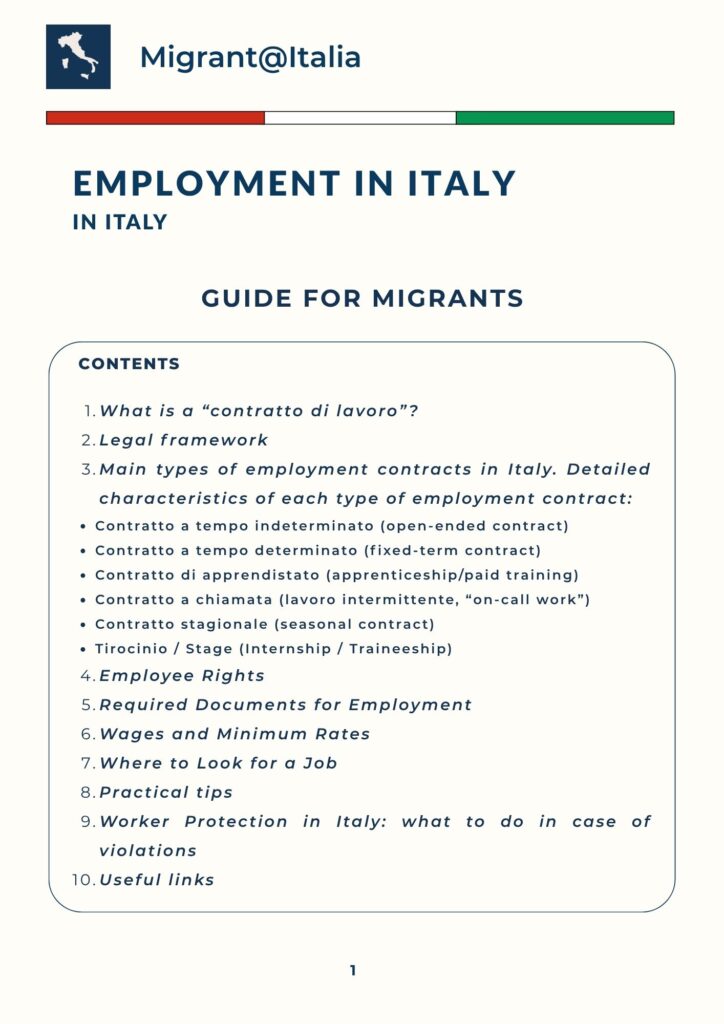
We’ve prepared a detailed PDF Guide for you — with all the key details, important information, and practical tips about Employment in Italy.
Download and use it as a ready-to-go manual!