

BANK ACCOUNT IN ITALY
1. Why you need a bank account in Italy
- Salary/fees (employment, Partita IVA), employer reimbursements.
- INPS social benefits (sick pay, family benefits, NASpI, etc.).
- Payments: rent, utilities, healthcare, kindergarten/school, university.
- Taxes and fees: F24, pagoPA, MAV/RAV, traffic fines.
- Digital services: SPID, IO, App Poste, booking via CUP.
- International transfers, online purchases, standing orders (SDD/RID).
Not having an account significantly complicates legal work, receiving benefits, and renting housing.
👤 2. Categories of foreigners who can open an account
⚖️ Правова база
- Згідно з Direttiva UE 2014/92/UE та італійським законодавством, будь-яка особа, що легально перебуває на території Італії, має право відкрити conto di pagamento di base (базовий рахунок).
- Це право поширюється не лише на резидентів, а й на іноземців з тимчасовим дозволом чи навіть зі статусом шукача притулку.
👤 Категорії іноземців, які можуть відкривати рахунок
- Громадяни ЄС
- Достатньо паспорта + codice fiscale.
- Більшість банків можуть попросити residenza (довідка з comune), але за законом достатньо domicilio.
- Громадяни країн поза ЄС
- Необхідно мати permesso di soggiorno або хоча б ricevuta postale (квитанція поштової подачі на permesso).
- У багатьох банках цього достатньо для відкриття conto base чи conto corrente.
- Шукачі притулку (richiedenti asilo)
- Мають право на conto di base з паспортом і cedolino/ricevuta C3 (підтвердження подачі).
- Часто банки не знають цієї норми → варто посилатись на MEF та Banca d’Italia.
- Тимчасово перебуваючі (віза, soggiorno breve)
- Більшість банків відмовляють, але онлайн-банки можуть відкрити рахунок з паспортом + codice fiscale.
🔹3. Types of accounts
1️) Conto corrente (current account)
The most common type of account.
- For daily financial operations: receiving salary, paying rent and utilities, bank transfers.
- Usually linked to a bank card (ATM/debit).
- May support F24, pagoPA, SDD/RID (direct debits).
- Maintenance: €3–12/month in traditional banks; sometimes free in online banks.
📌 Suitable for anyone planning to live and work officially in Italy.
2️) Conto di base (basic account)
A special account provided for by EU and Italian law (DPCM 28/01/2012).
- Intended for socially vulnerable groups: low-income persons, migrants, asylum seekers, pensioners.
- Fixed set of basic operations:
- receiving salary/pension;
- a minimum number of bonifici;
- debit card;
- payments to the state (F24, pagoPA).
- For people with ISEE ≤ €11,600 — free (no canone and no imposta di bollo).
- For others — very low fee (≈ €2–4/month).
- A bank must open a conto di base for anyone legally present in Italy (including richiedenti asilo, protezione temporanea).
📌 This is often the account recommended for newly arrived migrants.
3️) Conto deposito (deposit/savings account)
- Not for daily spending, but for holding money with interest.
- Two types:
- libero (withdraw anytime);
- vincolato (funds locked for 6–36 months, higher rate).
- Interest depends on the bank (≈ 2–4% in 2025).
- Not usable for salary or rent.
📌 Makes sense for savings, not as a primary account.
4️) Conto online (online account)
- Opened entirely remotely (app/website).
- Documents: passport/ID + codice fiscale, selfie/video verification.
- Usually lower fees than classic banks (canone €0–3/month).
- Convenient mobile app, push notifications, flexible limits.
- Downside: some online banks (Revolut, Wise) have EU-IBANs (LT, BE, NL) that are sometimes not accepted for SPID, pagoPA, or by landlords.
- Best options for migrants: N26 (IT-IBAN), Revolut, Wise.
📌 Ideal for those who want an account quickly right after arrival.
5️) Conto business / aziendale
- For Partita IVA, ditta individuale, società.
- Expanded features:
- paying F24 (taxes),
- integration with accounting software,
- multi-user access (for employees),
- business credit products.
- Higher fees than regular conti correnti (€10–25/month).
- The bank may require documents from the Camera di Commercio or proof of Partita IVA.
📌 Mandatory for entrepreneurs and companies. Not suitable for private individuals.
✅ Comparison
| Account type | For whom | Cost | Features |
| Conto corrente | All private individuals | €3–12/month | Most common; for salary and daily expenses |
| Conto base | Social categories, refugees, low ISEE | €0–4/month | Guaranteed by law; simple package |
| Conto deposito | For storing funds | Free / with conditions | Not for salary or utilities |
| Conto online | Newcomers, youth, migrants | €0–3/month | Instant opening; sometimes non-IT IBAN |
| Conto business | Partita IVA, companies | €10–25/month | For entrepreneurs; accounting integration |
📑 4. Documents to open a bank account in Italy
🔹 1. Passport / ID (valid identity document)
- The main document for client identification (KYC / Antiriciclaggio – anti-money-laundering rules).
- EU citizens: a national ID card may suffice.
- Non-EU citizens: a foreign passport is mandatory.
👉 If your passport is close to expiry (less than 6 months), renew it—banks may refuse.
🔹 2. Codice Fiscale
- The identification tax number; no bank will open an account without it.
- Obtained free at Agenzia delle Entrate or an Italian consulate.
- Used for all financial and public procedures.
👉 If you do not yet have a plastic card, a paper certificate (attestazione) is enough.
🔹 3. Permesso di soggiorno / ricevuta postale
- Often required by offline banks to confirm legal stay.
- Both the permesso and the ricevuta postale (postal receipt for renewal/application) are accepted.
- Online banks (N26, Wise, Revolut) usually do not require a permesso—only passport + codice fiscale.
👉 If a bank refuses to accept the ricevuta postale, go to another bank/branch or assert your rights.
🔹 4. Proof of address
A bank must have your domicilio/residenza in Italy. Accepted proofs:
- registered lease contract (contratto di locazione registrato with Agenzia delle Entrate);
- dichiarazione di ospitalità (if you live with friends/relatives);
- bolletta (utility bill in your name);
- dichiarazione di domicilio registered with the Comune.
👉 If you have just arrived and have none of these → open an online account that does not require residenza.
🔹 5. FATCA / CRS
- For U.S. citizens → FATCA self-certification (Foreign Account Tax Compliance Act).
- For others → CRS (Common Reporting Standard), confirming your tax residence.
👉 Not a mere formality: banks share information with your country of tax residence.
🔹 6. Proof of income / contract (sometimes)
- Not needed to open a basic conto corrente, but required for a credit card, overdraft, or loan.
- Evidence may include:
- busta paga (payslip);
- contratto di lavoro;
- dichiarazione redditi (Mod. 730 or Redditi PF);
- for entrepreneurs — Partita IVA documents.
👉 If you have just arrived and have no income yet → open a conto base/corrente with a debit card. Credit products can be added later.
🔹 5. Where to open an account
Traditional banks (branches)
- Intesa Sanpaolo, UniCredit, BPER, Banco BPM, Crédit Agricole, BancoPosta (Poste).
- Pros: IT-IBAN, cash desks, broad network, in-branch services.
- Cons: queues, fees, more paperwork.
Online banks
- N26 (IT-IBAN), Wise (BE-IBAN), Revolut (LT-IBAN), bunq (NL-IBAN).
- Pros: fast, English-language interface, cheap international transfers.
- Cons: not always support F24/pagoPA/SDD; can be harder to obtain statements accepted by authorities.
🏦 6. How to open a bank account: step by step
🔹 Opening at a branch (offline bank)
- Book an appointment
- For large banks (Intesa, UniCredit, Poste) book online or by phone.
- Smaller banks may accept walk-ins, but they may refuse due to workload.
- Documents
Bring originals and copies:- passport;
- codice fiscale;
- permesso di soggiorno / ricevuta (or visa);
- proof of address (residenza/domicilio/ospitalità, bolletta or lease).
👉 Make clear you are opening as a consumer (private individual) and request a conto base or standard conto corrente, not a business account.
- Questionnaire (KYC / Antiriciclaggio)
The bank must identify clients:- KYC form: personal data, source of funds, country of tax residence;
- GDPR consent;
- CRS/FATCA self-certification.
📌 Standard for everyone, including Italians.
- Signing the contract
- You sign the contratto di conto corrente.
- You must be given the Foglio informativo — the official tariff sheet (all fees, limits, conditions).
👉 Save it as a PDF or printout; it is crucial in any dispute.
- Receiving the IBAN and card
- Your IBAN is assigned immediately after signing.
- You can start receiving/sending transfers right away.
- The debit card (Visa/Mastercard/Maestro/Postepay) arrives by post within 3–10 days; some banks issue a temporary card at once.
- Activating the account and card
- You get access to mobile/online banking (home banking).
- Set up two-factor authentication (SCA): SMS-OTP, push notifications, or token.
- For the card: activate the PIN at an ATM or via the app.
🔹 Opening online (digital/fintech banks)
- Sign-up
- Download the app (N26, Wise, Revolut, bunq).
- Fill a short form: name, address, codice fiscale.
- Verification
- Photo of your passport/ID.
- Video verification or selfie with the document.
- For EU citizens sometimes ID + codice fiscale is enough; for extra-EU — passport.
- Address confirmation
- In most cases a self-declaration is enough (you enter the address).
- Some banks (e.g., N26) may ask for a bolletta or lease upload.
- Receiving IBAN and card
- IBAN is assigned instantly after verification.
- You can immediately make SEPA transfers.
- A virtual card appears in the app; the physical card arrives by mail.
- Setup
- Activate the card in the app.
- Add to Apple Pay / Google Pay.
- Set transaction limits.
- Enable push confirmations for every operation.
🔹 Closing an account
Under Italian law (“Legge Bersani”, D.L. 223/2006):
- closing a personal account is free of charge;
- you may submit the request at the branch or send a PEC (posta elettronica certificata) to the bank’s Ufficio Reclami;
- the bank must close the account within a reasonable time (usually up to 30 days).
📌 Banks often try to delay — insist on your right: “conto corrente: chiusura gratuita per legge Bersani.”
💰 7. Fees in Italy
🔹 1. Canone mensile (monthly maintenance)
- Classic banks (Intesa, UniCredit, BPER, BancoPosta) charge €3–12/month.
- Online banks (N26, Wise, Revolut, bunq) are often free or €0–3/month.
- In many plans you can avoid the fee if:
- salary/pension is credited (accredito stipendio/pensione);
- you activate at least one SDD (direct debit);
- you are under 30 (youth packages).
🔹 2. Bonifico SEPA
- Standard SEPA transfer (up to €50,000) usually costs €0–1.50; online it is almost always free.
- Bonifico SEPA Instant costs more: €1–3 depending on the bank.
- Some online banks (Revolut, Wise, bunq) offer free instant transfers.
🔹 3. ATMs
- Withdrawals at “other” banks’ ATMs cost €1.5–2.5 per operation.
- Free at your own bank’s ATMs (e.g., Intesa, UniCredit).
- Online banks often give 5 free withdrawals/month, then a fee applies.
🔹 4. SDD / RID (direct debits)
- Utilities, rent, mobile internet, Netflix, etc. are typically set up via SDD.
- These operations are almost always free.
- Important: if your balance is insufficient → the bank may charge an insoluto fee (failed debit).
🔹 5. Imposta di bollo (government stamp duty)
- €34.20/year (≈ €8.55 every 3 months).
- Charged only if the average yearly balance > €5,000.
- Conto di base and some social categories (low ISEE, richiedenti asilo) are exempt.
🔹 6. Foglio informativo
- By law every bank must provide a Foglio informativo (PDF with all fees).
- It lists even hidden costs: statement printing, account closure, card blocking.
- 👉 Always request and keep this document; it is key in disputes.
🔹 8. Security
- Enable two-factor authentication, limits, and push notifications.
- Never disclose OTP/PIN by phone/chat.
- Verify the IBAN/payee before a bonifico (anti-spoofing).
- Keep PEC/certified mail for official correspondence.
🔹 Complaints and protection of rights
- File a written complaint with the bank’s Ufficio Reclami (by PEC/registered mail). The bank must reply within 60 days.
- If unsatisfied — apply to ABF (Arbitro Bancario Finanziario) online (small fee, quick process).
- For EU-IBAN discrimination — inform the Banca d’Italia or Antitrust.
- For disputes regarding payments to public bodies — contact the relevant ente creditore (Comune, Region, etc.).
9. Useful links
- Banca d’Italia → Transparency, consumer rights, ABF: https://www.bancaditalia.it
- MEF / “Conto di base” → Official information on the basic account: https://www.mef.gov.it
- Agenzia delle Entrate → Codice Fiscale, F24: https://www.agenziaentrate.gov.it
- PagoPA → Government online payments: https://www.pagopa.gov.it
- Poste Italiane / BancoPosta: https://www.poste.it
- N26: https://n26.com | Wise: https://wise.com | Revolut: https://revolut.com | bunq: https://www.bunq.com
Frequently Asked Questions (FAQ)
Can I open an account without a permesso?
Yes, at most online banks — passport + codice fiscale is enough.
- Will payroll be paid to an EU-IBAN?
Yes, but some employers ask for an IT-IBAN; agree in advance.
- What is a conto base and who gets it free?
A basic consumer account; for vulnerable categories/low ISEE it is often €0.
- How much does maintenance cost?
Online — from €0; offline — €3–12/month. Check the tariff sheet.
- How to pay F24 and pagoPA from an online bank?
Via the app/web. If unsupported, use another bank/post office or an intermediary service.
- Can I open an account for a child?
Yes, together with a parent/guardian; age-based limits apply.
- What is the €34.20 imposta di bollo?
An annual stamp duty on statements if the average yearly balance > €5,000 (for individuals).
- Is an account mandatory for renting?
Almost always yes; cash is increasingly not accepted.
- How fast do I get the card?
At branches — virtual/temporary immediately; plastic card arrives by post in 3–10 days.
10. How do I close an account?
Submit a request. The bank may not charge a closure fee.
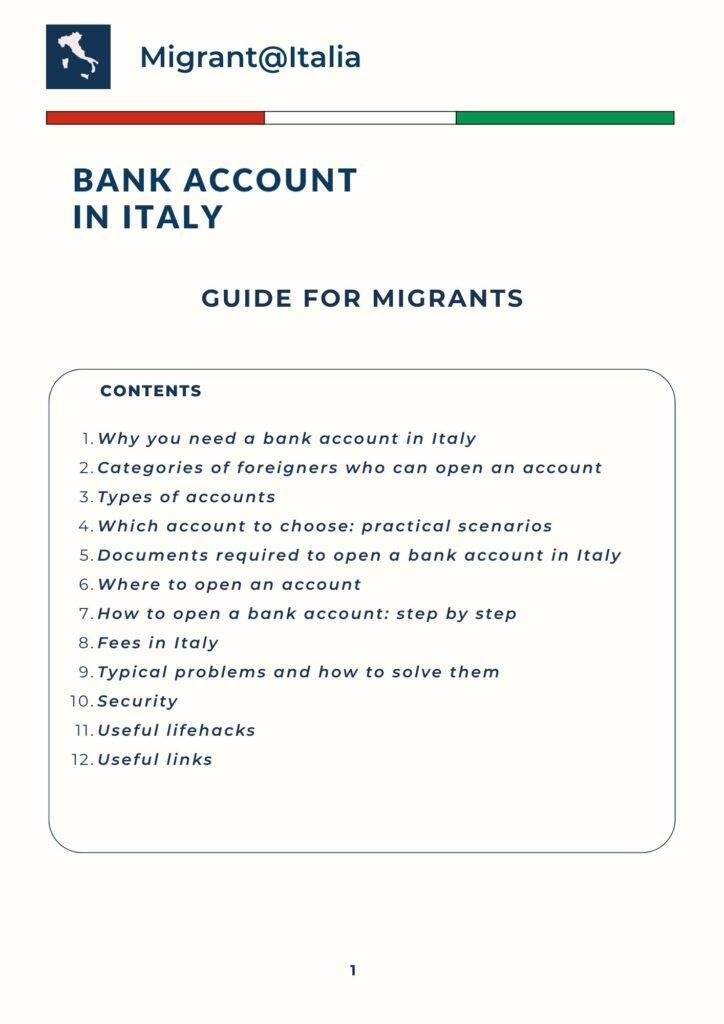
We’ve prepared a detailed PDF Guide for you — covering all the steps and procedures for opening a Bank account in Italy.
Download and use it as a ready-to-go manual!