
Entrepreneurial Activity in italy
PARTITA IVA
❓ 1. What is a Partita IVA
Partita IVA is an individual taxpayer identification number opened with the Agenzia delle Entrate (Italy’s tax authority) in order to carry out entrepreneurial or professional activity.
📌 If you provide services or sell goods on a regular basis and receive income for it, you are required to open a Partita IVA.
🛠️ What a Partita IVA is for
It allows you to legally:
- Issue invoices (fatture) to clients and companies.
- Conduct commercial activity: a shop, online sales (Etsy, Amazon, eBay, Shopify).
- Provide services (repairs, cleaning, translation, IT, consulting).
- Work as a freelancer on international projects.
- Carry out a craft activity (artigiani: construction workers, tradespeople, hairdressers).
👉 Without a Partita IVA you can only work via a contratto di lavoro (employment contract) or carry out occasional work through a prestazione occasionale (up to €5,000/year).
📘 2. Legal framework
- Codice Civile, art. 2222 — defines the activity of a “lavoratore autonomo.”
- DPR 633/1972 — regulates VAT (IVA).
- Legge 190/2014 — introduced the simplified tax regime (regime forfettario).
- D.Lgs. 81/2015 (Jobs Act) — delineation between lavoro subordinato (employee) and lavoro autonomo.
⚖️ Comparison: Partita IVA vs Employment
| Criterion | Employment (Contratto) | Partita IVA |
| Income | Fixed salary (busta paga) | As much as you earn yourself |
| Taxes | Withheld by employer | You file your own return |
| INPS | Paid by employer | You pay yourself (Gestione Separata / Artigiani) |
| Vacation/sick leave | Yes, paid by employer/INPS | None (if self-employed) |
| Stability | Higher (contract, guarantees) | Lower, depends on clients |
| Autonomy | Limited by employer | Full independence |
🏷️ 3. Forms and types of activity for a Partita IVA
🔹 👨💻 3.1. Libero professionista (independent professional)
Libero professionista is a Partita IVA form for individuals who perform intellectual or professional activities without creating an enterprise.
- Suited to those who provide services rather than sell goods.
- Does not require registration with the Camera di Commercio (unlike a ditta individuale).
- A simple option for freelancers, consultants, and specialists.
📂 Types of professional activities
- Professions without professional orders (senza albo/ordine professionale)
- IT freelancers;
- translators;
- marketers, SEO specialists;
- designers;
- photographers;
- consultants (business, HR, finance).
👉 For these professions, it is sufficient to open a Partita IVA with the Agenzia delle Entrate.
- Professions with professional orders (con albo/ordine professionale)
- lawyers (ordine degli avvocati),
- engineers (ordine degli ingegneri),
- doctors, dentists, nurses (ordine dei medici),
- architects, notaries, psychologists.
👉 Here, registration with the professional order is required. Contributions are paid not into the Gestione Separata INPS, but into special funds (Casse Professionali), for example:
- Cassa Forense (for lawyers),
- Inarcassa (for architects and engineers),
- ENPAM (for medical professionals).
⚖️ Tax regimes for a libero professionista
🔹 1. Regime forfettario (simplified regime)
- Income up to €85,000/year.
- Tax:
- 5% for the first 5 years (for new activities).
- 15% from the sixth year onward.
- No need to charge IVA or keep complex accounts.
- The return is filed once a year.
- You also pay INPS Gestione Separata (~26.07%).
📊 What is the coefficiente di redditività
Under the forfettario, tax is not calculated on the entire revenue (fatturato), but only on a portion of it.
This portion is determined by the “coefficiente di redditività” (profitability coefficient).
- It indicates what share of your turnover (fatturato) the state treats as “net profit” after expenses.
- This percentage varies depending on your sector (defined by your ATECO code).
👉 That is: taxable income = fatturato × coefficiente di redditività.
📌 Important points
- Under the forfettario, expenses are not directly deducted (there is no deduction of actual expenses as in the ordinario).
- Instead, a fixed coefficient applies → the state assumes you have that level of expenses “by default.”
- The lower the coefficient, the more favorable (more “virtual” expenses).
- For example, in trade (67%) taxes are lower because it is assumed you have high purchasing costs.
- In consulting (78%) expenses are low, so the taxable base is higher.
🔹 2. Regime ordinario (standard regime)
⚖️ Key characteristics
- No income cap (you can earn €100,000 or €1,000,000).
- Applies mandatorily if:
- you exceed the €85,000/year limit (then you automatically exit the forfettario);
- your activity requires operating with IVA (for example, import/export, wholesale, working with large companies that reclaim IVA).
📊 Taxes under the Regime ordinario
- IRPEF (Imposta sul Reddito delle Persone Fisiche)
- Progressive brackets:
- 23% → up to €15,000
- 25% → €15,001–28,000
- 35% → €28,001–50,000
- 43% → over €50,000
- Additionally: regional tax (1–3%) and municipal tax (0.5–1%).
- Progressive brackets:
- IVA (Imposta sul Valore Aggiunto)
- Standard rate: 22%.
- Reduced rates: 10% (restaurants, food), 4% (essentials, books).
- You issue invoices with IVA (fattura con IVA).
- IVA paid to suppliers (IVA a credito) can be offset against the IVA collected from clients (IVA a debito).
- INPS
- Contributions depend on the type of activity:
- Libero professionista senza albo → Gestione Separata (≈ 26%).
- Artigiani/Commercianti → fixed minimum ≈ €4,200/year + % of profit.
- Professions con albo → Cassa Professionale.
- Contributions depend on the type of activity:
📂 Expense accounting (deduzioni e detrazioni)
Under the ordinario you can deduct actual expenses from income, reducing the taxable base.
Examples of deductible expenses:
- office or studio rent;
- equipment, computers, furniture;
- phone, internet, electricity;
- transport expenses (fuel, tickets);
- advertising costs, websites;
- accountant’s services;
- professional courses.
📌 The more documented expenses → the lower the taxable profit.
🧾 Reporting and obligations
- Quarterly IVA filings (LIPE — Liquidazioni IVA periodiche).
- Annual IVA return (in April).
- Modello Redditi Persone Fisiche (annually, by November 30).
- F24 — the form for tax payments (at least twice a year: saldo + acconto).
- Bookkeeping: income and expense ledger, IVA registers.
👉 In practice, operating under the ordinario without a commercialista (accountant) is nearly impossible.
✅ When the Regime ordinario is advantageous
- If your income exceeds €85,000/year (forfettario no longer available).
- If you have many expenses to deduct (rent, purchases, equipment).
- If you work with large companies or in import/export (they require IVA).
- If you plan to scale your business significantly.
❌ Downsides
- More complex bureaucracy (quarterly filings).
- Accountant’s costs: €800–€1,500/year.
- High IRPEF rates for large incomes.
- Not always advantageous for freelancers with low expenses.
🔑 Conclusion
The Regime ordinario is the “grown-up” regime for entrepreneurs with high turnover or substantial expenses. It is more complex and costlier to manage, but it allows you to deduct all expenses and work with big companies.
🏦 INPS contributions for a libero professionista
🔹 1. Professions without a professional order → Gestione Separata INPS
These are all “free professions” that do not require membership in a professional order (translators, IT specialists, designers, consultants, etc.).
- Contributions: 26.07% (rate for 2025).
- Calculated on net income (i.e., after applying the coefficient under the forfettario or actual expenses in the ordinario).
- Payments:
- 1st payment: June 30 (saldo + 1° acconto).
- 2nd payment: November 30 (2° acconto).
- In some cases — a 3rd payment in January of the following year.
- Instrument: via the F24 model (online banking or through an accountant).
📌 Important: the Gestione Separata has no minimum contributions — if your income is 0, you do not have to pay. But this is a downside if you want continuous contribution records (contributi).
🔹 2. Professions with a professional order (regulated professions) → Casse Professionali
These are “ordinistiche” professions (lawyers, doctors, architects, engineers, etc.).
- Contributions are paid not to INPS, but to special professional pension funds (Casse di Previdenza Professionali).
- Rates vary, but usually:
- an annual minimum contribution (≈ €2,000–€4,000, even with zero income);
- additional percentages on income (15–20%).
- Examples:
- Cassa Forense (lawyers): minimum contribution + 14% of income.
- Inarcassa (engineers, architects): minimum contribution + 14.5%.
- ENPAM (medical professionals): depends on age and specialization.
📌 Important: even if you earned nothing, the minimum contribution is mandatory.
🔹 3.2. Ditta individuale (sole proprietorship)
⚖️ Core definition
Ditta individuale is a business form in Italy suitable for those engaged in:
- trade (negozio, e-commerce, Amazon, eBay),
- crafts (artigiani: construction, plumbing, electricians, beauty professionals),
- production (bakeries, cafés, small workshops).
👉 Unlike a libero professionista, here the activity is not only intellectual; it involves physical services or selling goods.
🏢 Registration
- Mandatory through the Camera di Commercio (business register – Registro delle Imprese).
- At the same time:
- the Partita IVA is opened with the Agenzia delle Entrate,
- registration with INPS (Artigiani or Commercianti),
- in some sectors — with INAIL (occupational risk insurance).
- The procedure is usually handled through an accountant (commercialista).
📌 Start-up costs: about €150–€250 for registration + accountant’s fee (€50–€150).
💶 Taxes and regimes
As with a libero professionista, a ditta individuale can operate under two regimes:
- Regime forfettario (simplified):
- income limit: €85,000/year;
- tax: 5% (first 5 years), then 15%;
- no IVA;
- simple accounting (no complex bookkeeping).
- Regime ordinario:
- no income cap;
- IRPEF on a progressive scale (23–43%);
- with IVA;
- you can deduct actual expenses (rent, purchases, transport, advertising).
- accountant required.
🏦 INPS contributions (Artigiani / Commercianti)
Unlike the Gestione Separata for freelancers, here there are fixed minimum contributions that must be paid even with zero income.
- Minimum ≈ €4,200/year (2025).
- If profit exceeds a certain threshold (~€17,000), an additional percentage applies (≈ 24%).
- Payment quarterly (via F24).
📌 This is the main drawback of a ditta individuale for those unsure about stable income: you’ll have to pay the INPS minimum even without clients.
👥 Employees
- A ditta individuale can hire employees (assunzioni).
- You must register them with INPS/INAIL, pay wages, and make contributions.
- The employer must comply with CCNL rules.
📂 Entrepreneur’s obligations
- Issue and manage invoices (fatture).
- Keep an income and expense ledger (mandatory under the ordinario).
- Pay taxes and contributions within deadlines.
- Pay the annual Camera di Commercio fee (~€50–€150).
✅ Advantages
- You can engage in trade and crafts (which a libero professionista cannot).
- You can have employees.
- The business is officially registered with the Camera di Commercio (more trust from clients/partners).
- Under the forfettario — advantageous for modest income.
❌ Disadvantages
- Mandatory INPS contributions (~€4,200/year minimum, even with no income).
- More bureaucracy than a libero professionista.
- Annual Camera di Commercio fee.
- Under the ordinario → complex accounting; a commercialista is needed.
🔹 3.3. Società (legal entities)
⚖️ General definition
Società is a legal business form in Italy suitable for medium and large enterprises when:
- you work not alone but with partners;
- you need investments;
- you plan to hire employees;
- you have large turnovers that cannot be managed through a simple Partita IVA.
📌 Registration takes place in the Registro delle Imprese (Camera di Commercio) through a notary.
🔹 Types of società
- S.n.c. (Società in nome collettivo)
- General partnership (similar to a Ukrainian general partnership).
- All partners are personally and jointly liable with all their assets.
- Decisions are taken collectively.
- Used for small businesses with high trust among partners.
👉 Downside: risk — company debts = partners’ personal debts.
- S.a.s. (Società in accomandita semplice)
- Two types of partners:
- Accomandatari → unlimited personal liability.
- Accomandanti → risk limited to invested capital (limited liability).
- Used when some partners only invest money while others actively manage the business.
- Two types of partners:
- S.r.l. (Società a responsabilità limitata)
- Equivalent to an LLC (limited liability company).
- Partners risk only the contributed capital (minimum €10,000).
- The most common form for medium-sized business.
- Has its own legal personality, separate from the founders’ assets.
- Suitable for businesses with employees, significant turnover, cooperation with banks and investors.
📌 Plus: limited liability.
📌 Minus: high management costs (notary, accountant, reporting).
- S.r.l.s. (Società a responsabilità limitata semplificata)
- Simplified S.r.l., created for startups and young entrepreneurs.
- Minimum share capital: from €1 to €9,999.
- Cheaper registration (reduced notarial costs).
- Simpler governance structure.
- Good for those who want to start with partners without large upfront costs.
📊 Taxes for Società
- IRES (Imposta sul Reddito delle Società) → 24% of profit.
- IRAP (Imposta Regionale sulle Attività Produttive) → ≈ 3.9% (depends on the region).
- IVA — same as under the ordinario (standard VAT).
- INPS → depends on category (partners, employees).
📌 Unlike a Partita IVA (natural person), here the tax is not progressive but a fixed percentage of profit.
📂 Accounting and reporting
- Mandatory double-entry bookkeeping (contabilità ordinaria).
- Annual financial and tax reporting.
- A commercialista (accountant) is mandatory.
- Management costs: €1,500–€3,000/year and up.
✅ Advantages of a Società
- Limited liability (except S.n.c.).
- A prestigious form — convenient for working with large companies, banks, and investors.
- Potential to scale the business.
- Separation of personal and company finances.
❌ Disadvantages
- High costs for setup and management.
- Complex bureaucracy.
- Requires an accountant + notary.
- Minimum share capital (especially for S.r.l.).
🧾 4. How to open a Partita IVA: step by step
1️) Choose the activity form
Before opening, decide which form you will operate in:
- Libero professionista (independent professional)
👉 For intellectual and creative services: translation, programming, design, consulting, marketing.
- Registration directly with the Agenzia delle Entrate.
- Contributions to the Gestione Separata INPS.
- No need to register with the Camera di Commercio.
- Ditta individuale (sole proprietorship)
👉 For trade, crafts, handiwork, cafés, e-commerce, construction.
- Mandatory registration with the Camera di Commercio.
- Contributions to INPS Artigiani/Commercianti (minimum ≈ €4,200/year even with zero income).
- You can hire employees.
- Società (S.r.l., S.r.l.s., others)
👉 For medium and large businesses with partners or investments.
- Registration through a notary with the Registro delle Imprese.
- Taxes: IRES (24%) + IRAP (~3.9%).
- Complex accounting, high management costs.
📌 Your choice affects: taxes, INPS, bureaucracy, costs, and capabilities (e.g., whether you can hire employees).
2️) Choose an ATECO code
Every type of activity in Italy has its ATECO code. It determines:
- what exactly you do;
- the coefficiente di redditività (under the forfettario), used to calculate the tax base;
- the INPS rate and eligibility for certain benefits.
3️) Choose the tax regime
This is where you decide how you will pay taxes:
- Regime forfettario (simplified):
- Income limit: ≤ €85,000/year.
- Tax: 5% (first 5 years), then 15%.
- No IVA.
- Uses the coefficiente di redditività (e.g., 78% for consultants, 67% for trade).
- Very simple reporting.
👉 The most advantageous option for beginners, freelancers, and small businesses.
- Regime ordinario (standard):
- No income limit.
- IRPEF (23–43% progressive).
- IVA is mandatory.
- You can deduct actual expenses (rent, equipment, transport, advertising).
- Complex accounting; a commercialista is needed.
👉 Suitable for high turnover and expense-heavy businesses.
4️) Registration with the Agenzia delle Entrate
- Fill in the AA9/12 form (for individuals).
- Submit:
- in person at the office;
- via PEC (certified email with signature);
- through an accountant (commercialista).
- Registration is free.
📌 The form must include:
- ATECO code;
- tax regime (forfettario/ordinario);
- data on residenza/domicilio.
5️) Registration with INPS
Within 30 days of opening your Partita IVA you must register with INPS.
- Gestione Separata → for freelancers without professional orders.
- Artigiani / Commercianti → for a ditta individuale.
- Cassa Professionale → for professions with professional orders (lawyers, doctors, engineers).
📌 In the Gestione Separata there is no minimum → you pay only based on income.
📌 For Artigiani/Commercianti the minimum contribution is ≈ €4,200/year → even if your income is 0.
6️) Additional steps
- PEC (posta elettronica certificata): mandatory legal email.
- Firma digitale (digital signature): required for online procedures.
- Taxpayer QR code (obtained from the Agenzia delle Entrate).
- For a ditta individuale — the Camera di Commercio annual fee (≈ €50–€150).
📊 5. Tax returns and tax payments
🔹 1. Income tax return
- All Partita IVA holders must file the Modello Redditi Persone Fisiche (ex Unico PF) annually.
- Submission:
- online via the Agenzia delle Entrate website (with SPID/CIE/CNS);
- through an accountant (commercialista or CAF).
- Deadline: by November 30 of the year following the tax year.
- Example: for 2024 income, the return must be filed by 30.11.2025.
📌 Under the forfettario the return is simpler: you report only turnover, and the coefficiente di redditività is applied.
📌 Under the ordinario the return is complex: you must report all income, expenses, and IVA.
🔹 2. Tax payments
Taxes are paid in two (sometimes three) installments:
- Saldo (final settlement for the previous year)
- Payment of the difference between what you owed for the past year and what you already paid as “acconti.”
- Deadline: by June 30 of the following year.
- Primo acconto (first advance payment for the current year)
- Together with the saldo (also by June 30).
- Usually 40% of the expected tax for the current year.
- Secondo acconto (second advance payment)
- Deadline: by November 30 of the same year.
- Usually 60% of the expected tax.
📌 If the total acconto < €257.52 → it may be omitted.
🔹 3. The F24 form
- All taxes (IRPEF, INPS, IVA, addizionali) are paid via the F24 model.
- This is a standard tax form you can pay:
- via online banking (almost all Italian banks offer a “Pagamento F24” function);
- at the bank or post office (only for some categories).
- The F24 includes:
- your codice fiscale;
- the codice tributo (tax code);
- the year the tax is due for;
- the amount.
📌 The accountant usually prepares the F24 and sends you the file for payment or pays online on your behalf (with your authorization).
🚨 6. Penalties and liability
Italian tax law (DPR 600/1973, DPR 633/1972, Legge 212/2000 – Statuto del Contribuente) provides strict sanctions for missed deadlines and underpaid taxes.
🔹 1. Late or missing return (omessa o tardiva dichiarazione)
- If you do not file the Modello Redditi by November 30:
- a fine from €250 to €1,000;
- if the return included taxes due → an additional fine equal to 120–240% of the unpaid taxes.
- If you are up to 90 days late → it is considered a “tardiva dichiarazione,” which can be corrected with a lower fine (~€25 + % of the tax).
🔹 2. Underpayment of taxes (omesso o insufficiente versamento)
- If you underreport income or miscalculate taxes:
- fine of 90–180% of the amount due;
- interest (interessi legali, currently ≈ 5% per year).
🔹 3. Late payment (ritardato pagamento)
- If taxes are correctly declared but you pay after the deadline:
- penalty 0.1% per day of delay (first 14 days);
- 1.5% for delay up to 30 days;
- 1.67% for delay up to 90 days;
- 3.75% for delay up to 1 year.
👉 The ravvedimento operoso mechanism applies — “voluntary correction”:
- If you pay late voluntarily, penalties are reduced.
- The faster you correct, the lower the penalty.
🔹 4. Other violations
- Errors in F24 (wrong codice tributo, year, amount) → the payment may be considered invalid, penalized as an underpayment.
- Failure to register with INPS → backdated debt assessments + fines.
- Unregistered workers (lavoro nero in a ditta individuale or società) → a fine of €1,800–€10,800 per worker.
📎 Useful links:
- Agenzia delle Entrate – agenziaentrate.gov.it
- INPS – inps.it
- Normattiva – normattiva.it
- Camere di Commercio – unioncamere.gov.it
- Online services for Partita IVA: fiscozen.it, flextax.it
Frequently Asked Questions (FAQ)
Can I open a Partita IVA without a Permesso di soggiorno?
❌ No. For non-EU citizens, a valid permesso with the right to work (autonomo, familiare, protezione, etc.) is required.
- How much does it cost to open a Partita IVA?
- Directly at the Agenzia delle Entrate — free.
- Through an accountant (commercialista) — €50 to €150 for the service.
- Do I have to pay taxes if I earned nothing?
- For a libero professionista (Gestione Separata) — if income = 0 → no taxes are due.
- For a ditta individuale (Artigiani/Commercianti) — the INPS minimum contribution ≈ €4,200/year is always due, even with zero income.
- Which regime is better: forfettario or ordinario?
- If income ≤ €85,000 and expenses are low → forfettario (5–15%).
- If income is high or expenses are significant → ordinario (IRPEF 23–43%).
- Do I need an accountant?
- Under the forfettario you can keep your own accounts (but it’s advisable to use an accountant for the return).
- Under the ordinario and for società an accountant is mandatory.
- How are taxes paid?
- Via the F24 form (online banking or through an accountant).
- In two installments: saldo + acconti (June 30 and November 30).
- Can I have both a Partita IVA and an employment contract at the same time?
✅ Yes. This is called doppio lavoro. But:- you must declare income from both sources;
- the tax burden increases.
- What happens if I don’t file a return?
- Minimum fine €250 + interest.
- If income is hidden → fine 90–180% of the amount due.
- Is a bank account mandatory for a Partita IVA?
✅ Yes. Payments for business activity must go through a bank account or Postepay Evolution. Cash payments are prohibited for amounts over €999.99.
- How do I close a Partita IVA if I no longer work?
Without closing, you will continue to accrue INPS debts and fines.
Submit a request to the Agenzia delle Entrate (form AA9/12).
Close registration with INPS and, if applicable, the Camera di Commercio.
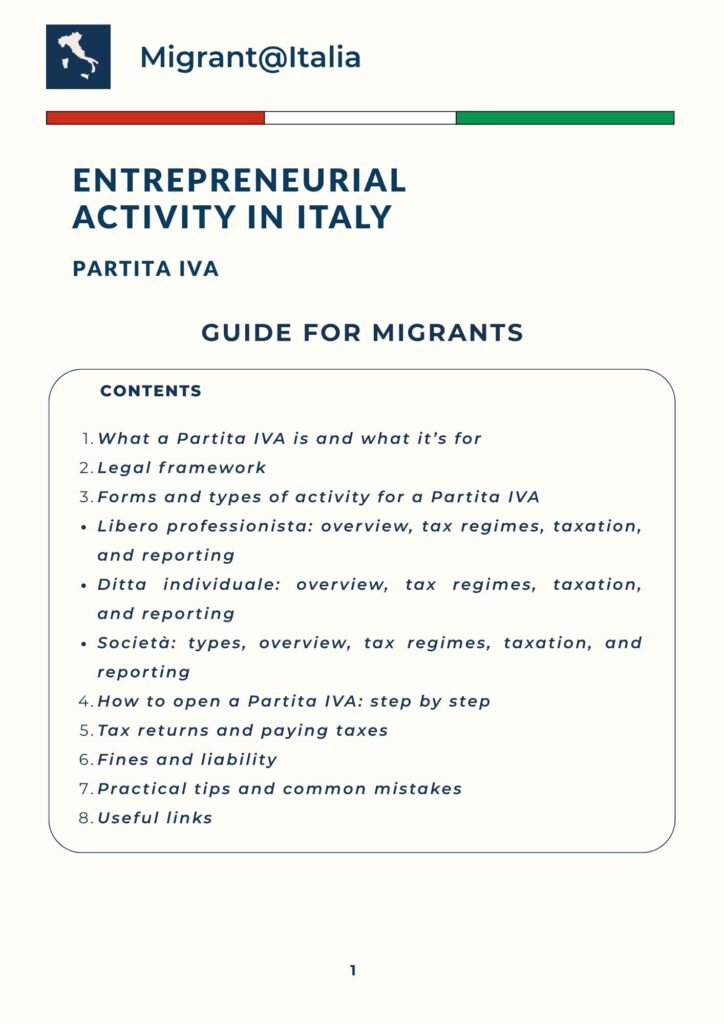
We have prepared for you a detailed PDF Guide: all the nuances, essential information, and practical advice for running entrepreneurial activities in Italy (Partita IVA).
Download and use it as a ready-to-go manual!