
Healthcare Services in italy
📘 1. General System: SSN (Servizio Sanitario Nazionale)
• SSN is the public healthcare system, financed by taxes.
• Managed by the Regions, but based on unified national principles.
• It provides:
– a family doctor (medico di base / pediatra di libera scelta),
– emergency care (118 / pronto soccorso),
– hospitalization, vaccination, and prevention.
• Everyone who legally resides in Italy (with a Permesso di soggiorno) has the right to access.
📘 2. Registration with ASL (Azienda Sanitaria Locale)
ASL (Azienda Sanitaria Locale) is the local health authority that coordinates family doctors, pediatricians, specialists, hospitals, and pharmacies in your Comune/Region.
This is where the official registration with the Servizio Sanitario Nazionale (SSN) takes place for all persons entitled to access healthcare.
📑 Documents required for registration
The list may vary slightly by Region, but typically you will need:
- Permesso di soggiorno
- If already issued — present the card.
- If still in process — the ricevuta postale (postal receipt of submission) is sufficient.
- In cases of protezione temporanea or richiesta asilo — you can register immediately after filing the C3.
- Codice Fiscale
- Registration is impossible without it, as the healthcare system is linked to your tax code.
- If you have not obtained it yet, it is issued by the Agenzia delle Entrate (often even before the Permesso).
- Residenza or dichiarazione di ospitalità / domicilio
- If you are registered at the Comune — the certificato di residenza is sufficient.
- If you do not yet have residenza but you live at an address officially (rental contract, ospitalità) — a dichiarazione di ospitalità from the property owner or a dichiarazione di domicilio is accepted.
- Identity document
- Passport or national ID card.
⏱️ Timeframe: usually the same day; the physical card arrives within 1–2 weeks.
🎫 Tessera Sanitaria after registration
Issued automatically after registration. Usually sent by post to your address within 1–2 weeks.
Validity: matches the Permesso di soggiorno (if your Permesso is valid for 2 years → the card is also for 2 years).
Used for all medical procedures, pharmacies, and tax deductions.
If your Permesso is renewed, you must also renew the Tessera (through ASL or Agenzia delle Entrate).
📘 3. Tessera Sanitaria / TEAM / TS-CNS
• Tessera Sanitaria (TS) — the plastic card granting access to healthcare and tax deductions.
• TEAM (the European side of the card) — entitles you to urgent care in the EU.
• TS-CNS (Carta Nazionale dei Servizi) — the electronic version with PIN/PUK to access:
– Fascicolo Sanitario Elettronico (FSE),
– CUP bookings,
– certificates from ASL,
– some services of INPS/Agenzia delle Entrate.
Important
• Loss/damage → request a duplicate through ASL or Agenzia delle Entrate.
• If you move, you must re-register your doctor/ASL.
You can find detailed information on Tessera Sanitaria here 👇
📘 4. Choosing a doctor (Medico di base / Pediatra di libera scelta)
In Italy, the entire system is centered on the family doctor (medico di base) or the pediatrician (pediatra di libera scelta). This is your first point of contact with the SSN and the gateway to specialist care.
🧑⚕️ Medico di base (family doctor)
📌 Who this is
• A general practitioner (medico di medicina generale) contracted with SSN.
• Sees adults (from age 14).
• Provides office visits, consultations, and issues prescriptions and referrals.
📑 Duties of the family doctor
- Prescriptions for medicines — to obtain drugs at a reduced price or free of charge at the pharmacy (ricetta rossa / dematerializzata).
- Referrals to specialists (impegnativa) — without this, specialist consultations within SSN are not possible.
- Sick notes (certificati di malattia) — for INPS and the employer.
- Certificates — for school, work, sports.
- Prevention — vaccinations, basic tests, screenings.
📌 Limits
• Does not provide highly specialized care.
• Limited visiting hours (usually 2–3 hours on specified days).
• Nights/weekends are covered by the Guardia Medica.
👶 Pediatra di libera scelta (pediatrician)
📌 Who this is
• A doctor who treats children from birth to 14 (in some Regions up to 16 for chronic conditions).
• Assigned through ASL in the same way.
📑 Duties of the pediatrician
• Monitoring development and vaccinations.
• Issuing prescriptions and referrals to pediatric specialists.
• Certificates for school/nursery.
• Supervision of preventive checkups.
🔎 How to choose a doctor
- At the ASL
• After registering with SSN, go to the sportello scelta e revoca del medico.
• You will be given a list of available doctors (addresses, hours, remaining slots).
• You choose a doctor and sign the request.
- Online (where available)
• In many Regions (Lombardy, Emilia-Romagna, Lazio) you can select/change your doctor via the FSE portal or with SPID/CIE.
🔄 Changing your doctor
• You can change once a year without explanation.
• At any time if you move to another Comune or if the doctor retires/closes their practice.
• In case of conflict or poor service → contact ASL and request a change.
🚑 5. Emergency care in Italy
Everyone on Italian territory (even without documents) has the right to urgent medical care. This is guaranteed by the Italian Constitution (art. 32) and health laws.
☎️ Emergency numbers
112 – the single European emergency number. Works in all Regions; the operator forwards the call to the appropriate service (ambulance, fire brigade, police).
118 – direct medical emergency number (Emergenza Sanitaria). In some Regions it is being integrated into 112.
📌 Calls are free and work even without a SIM card.
🏥 Pronto Soccorso (Emergency Department)
This is the emergency department in hospitals (Emergency Room).
They accept everyone, regardless of documents or Permesso di soggiorno.
Services for urgent cases are free of charge.
How the “triage” system works
Upon arrival a nurse assigns a priority color:
🔴 Rosso – critical condition (life-threatening) → immediate treatment.
🟠 Arancione – serious risk, rapid intervention.
🟡 Giallo – medium urgency.
🟢 Verde – minor issues, you may wait.
⚪ Bianco – non-urgent issues (e.g., uncomplicated cold). In this case you may be asked to pay a ticket (around €25–50).
📌 All urgent conditions (rosso, arancione, giallo) are treated free of charge.
👨⚕️ Guardia Medica (Servizio di Continuità Assistenziale)
The on-call doctor when your family doctor is unavailable:
at night (20:00–08:00), on weekends and public holidays.
Guardia Medica services are free or subject to a small ticket (~€10–20, depending on the Region).
The doctor can:
- examine the patient,
- issue a prescription,
- provide a certificate or referral,
- call an ambulance if necessary.
The phone number for the Guardia Medica varies by Region → find it on your ASL website or via Google (“Guardia Medica + [city]”).
📘 6. Paid vs free services in Italian healthcare
✅ Free services (SSN)
For those registered with the Servizio Sanitario Nazionale (SSN):
- Family doctor / pediatrician — consultations, prescriptions, referrals, sick notes.
- Vaccinations — mandatory for children and recommended for adults (flu, COVID, HPV, etc.).
- Emergency care — ambulance (118/112), pronto soccorso for urgent conditions.
- Hospitalization — surgeries, childbirth, intensive care.
- Preventive programs — mammography, Pap test, colorectal cancer screening (by age group).
💶 Ticket sanitario (co-payment)
The ticket is a partial payment for some services. Set by each Region, but general guidelines are:
- Specialist visit (cardiologist, dermatologist, etc.) → €20–36.
- Tests (blood, urine, ultrasound, X-ray) → €10–36 per package/referral.
- High-level diagnostics (CT, MRI, colonoscopy) → €36–70+.
- Pronto Soccorso (white/green code, non-urgent) → about €25.
📌 For urgent classifications (yellow/red) treatment is free.
🆓 Esenzione ticket (exemption from co-payment)
The State grants esenzione in these cases:
- Low income (ISEE):
- ISEE < €8,263.31 (single person) + €516.46 for each dependent.
- For families with ≥4 children → threshold ~ €11,362.05.
- Chronic and rare diseases — list established by Ministerial decree (e.g., diabetes, oncology, COPD).
- Pregnancy — all tests and ultrasounds included in the protocol are free.
- Disability — 100% or partial, depending on category.
- Age — children under 6 and seniors over 65 (subject to income < €36,151.98).
📌 In each case you are assigned an exemption code (E01, E02, E03…), indicated on the prescription.
🛡 7. Insurance (assicurazione sanitaria)
Beyond SSN, there are supplementary forms of coverage:
- Mandatory through employment
• All employees with a work contract (contratto di lavoro) are automatically included in SSN via taxes and INPS/INAIL contributions.
• Additionally, some collective agreements (CCNL) include health funds (casse sanitarie integrative).
- Examples: Fondo EST (commerce/services), FASI (managers/engineers), META Salute (metalworkers).
- They cover: dentistry, exams at private clinics, additional diagnostics, partial reimbursement for glasses or physiotherapy.
• Cost: paid by the employer (as part of CCNL); free or symbolic cost for the worker.
- Private insurance (assicurazioni private)
Voluntary policies purchased separately:
• Cover faster access to private doctors/clinics, hospitalization with enhanced amenities, dentistry.
• Cost:
- individual: €300–1,200/year,
- family: €800–2,000/year (depending on coverage, age, health).
• Companies: Unisalute, Allianz, Generali, AXA, Reale Mutua.
• Note: many insurers require that you already have SSN/Permesso.
- Iscrizione volontaria (for extra-EU students and temporary residents)
• If you are not working but want full SSN access → voluntary registration is possible.
• Pay an annual contribution at ASL:
- €387.34 (standard),
- €150–200 (students).
• Grants the same rights as standard SSN coverage through employment.
📘 8. Vaccination in Italy
Vaccination is part of the Servizio Sanitario Nazionale (SSN) and is governed by Law No. 119/2017, which sets mandatory vaccines for children and outlines adult preventive programs.
🧒 Mandatory vaccinations for children (up to 16)
Every child must be vaccinated against:
• Poliomielite,
• Difterite,
• Tetano,
• Pertosse,
• Epatite B,
• Morbillo,
• Rosolia,
• Parotite,
• Varicella — mandatory in some Regions.
📌 Without a vaccination certificate, a child may be refused admission to school or nursery.
Parents receive a Libretto vaccinale — a booklet with the vaccination schedule.
👩⚕️ Recommended vaccinations
Besides the mandatory ones, Italy provides free preventive vaccinations:
• Influenza — annually (especially for older adults, pregnant people, those with chronic conditions, healthcare workers).
• COVID-19 — free, even without a Tessera Sanitaria.
• Meningococco — for children and adolescents.
• Pneumococco — for those 65+ and people with chronic illnesses.
• HPV (Papillomavirus) — for adolescents (girls and boys).
📌 Vaccines are free if included in the Regional programs by age or indication.
🌍 Who is entitled to free vaccination
• Italian and EU citizens.
• Non-EU citizens with a Permesso di soggiorno.
• Children and adolescents — regardless of status.
• Pregnant people.
• People with chronic illnesses.
• Individuals with low income or without housing.
• Migrants with an STP code (Straniero Temporaneamente Presente).
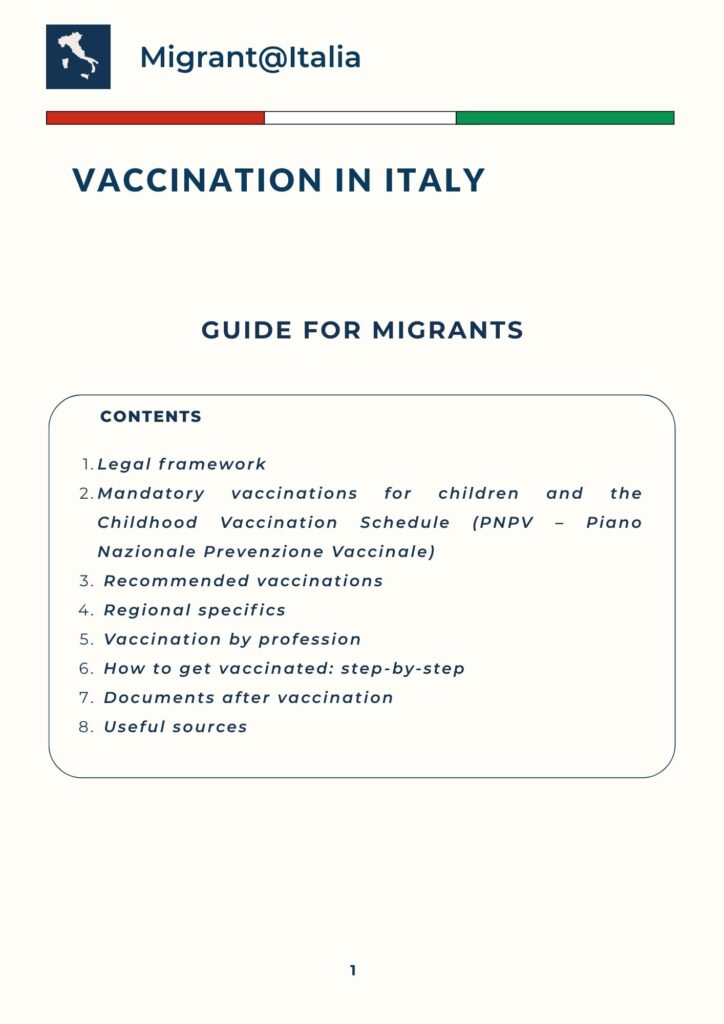
We’ve prepared a detailed PDF Guide for you about Vaccination in Italy.
📘 9. Fascicolo Sanitario Elettronico (FSE)
FSE is your personal electronic health record stored online. It collects and unifies all your healthcare information within the SSN.
🗂 What the FSE contains
All documents created within the SSN are automatically uploaded:
• blood, urine, and other lab tests,
• medicine prescriptions (ricette dematerializzate),
• impegnative (referrals to specialists),
• hospital discharge letters (lettera di dimissione),
• certificates, screening results,
• vaccination history,
• documents from pronto soccorso.
📌 You can also upload personal documents (e.g., private tests, PDFs from a doctor).
🔑 How to activate the FSE
- You need Tessera Sanitaria-CNS (TS-CNS) with PIN/PUK.
- Authenticate via SPID (Sistema Pubblico di Identità Digitale) or CIE (Carta d’Identità Elettronica).
- Each Region has its own portal:
- Lombardia → fascicolosanitario.regione.lombardia.it
- Lazio → salute.lazio.it/fse
- Emilia-Romagna → fse.regione.emilia-romagna.it
- Toscana → regione.toscana.it/fse
📌 If you do not yet have SPID/CIE → obtain it at the post office (Poste), a bank, or online.
⚙️ Functions of the FSE
• View results online — no need to pick up tests at the lab.
• Prescriptions — view and use the code at any pharmacy.
• Appointment booking — in some Regions integrated with CUP.
• Tax deductions — pharmacy receipts are automatically uploaded and counted in the 730 precompilata.
• Interaction with your doctor — your family doctor can view your history.
🔒 Privacy and access control
• You can hide specific entries (oscuramento) — e.g., if you don’t want a doctor to see a particular result.
• You can grant access to family members (e.g., parents to a child’s data).
• Access can be revoked at any time.
• All actions are logged; you can see who viewed your data.
🧾 Tax advantages
• All medical expenses (medicines, tests, visits) are recorded automatically.
• When filing your tax return (Modello 730 precompilato) these data are included as detrazioni fiscali (reductions of your taxable base).
• No need to keep paper receipts — just check that they appear in the FSE.
📘 10. Pharmacies and medicines (Farmacie e medicinali)
💊 How the system works
In Italy, medicines are sold exclusively in pharmacies. Categories by sale regime:
- Ricetta rossa (ricetta dematerializzata)
- Prescription issued by the family doctor or SSN specialist.
- Medicines are partially or fully covered by SSN → the patient pays only the ticket (symbolic amount).
- Examples: antibiotics, insulin, chronic-condition medications.
- Ricetta bianca
- Prescription from a private doctor or private specialist.
- Medicines are fully paid by the patient (not covered by SSN).
- Used for medications outside the “SSN protocol.”
- Farmaci da banco (OTC)
- Over-the-counter medicines: antipyretics, analgesics (paracetamol, ibuprofen), nasal sprays, etc.
- Fully paid by the patient.
🧾 Pharmacy receipts: scontrino parlante
• Each pharmacy receipt includes:
- the medicine name/code,
- the patient’s Codice Fiscale,
- the price.
• This is called the scontrino parlante (“speaking receipt”).
• It is necessary for the tax return, as medicine expenses are partially deductible (detrazioni fiscali).
💶 Tax deductions for medicines
• All medicine expenses supported by an scontrino parlante can be included in the dichiarazione dei redditi (Modello 730).
• The State refunds 19% of the amount exceeding €129.11 per year (franchigia).
• If you use the FSE (Fascicolo Sanitario Elettronico), purchases are uploaded automatically → you do not need to collect paper receipts.
👩🍼 11. Women’s health and childbirth in Italy
🤰 Pregnancy care (Gravidanza)
• Pregnancy and childbirth are free in Italy for all women, including those without documents (via the STP code).
• The principle of “tutela materno-infantile” applies — the State guarantees care for mother and child.
• Follow-up is provided at a consultorio familiare (family counseling center) or by private gynecologists accredited by the SSN.
📑 Esenzione ticket (fee exemption):
All tests and exams defined by the protocol (hormonal tests, ultrasounds, screenings) are free.
Standard protocol includes:
- 3 ultrasounds (first, second, third trimester),
- blood and urine tests,
- screenings for infections (toxoplasmosis, HIV, syphilis, hepatitis B, C),
- doctor/midwife consultations.
🏥 Childbirth (Parto)
- Childbirth is free in public hospitals and SSN clinics.
- Options may include:
- natural birth (parto naturale),
- caesarean section (parto cesareo), when indicated.
- Some hospitals offer parto in acqua (water birth) or rooming-in (baby stays with the mother in the room).
📌 Childbirth is provided in all cases, even without a Tessera Sanitaria or Permesso. A passport or STP is sufficient.
⚖️ Termination of pregnancy (Aborto / IVG – Interruzione Volontaria di Gravidanza)
- Regulated by Law 194/1978.
- Allowed up to 90 days from conception (≈12 weeks).
- Performed in public hospitals or clinics at the woman’s request.
- Free for everyone, including women without a Permesso.
📌 After 90 days, abortion is possible only for medical reasons (risk to the mother’s life or severe fetal pathologies).
👩⚕️ Prevention and screenings
Italy guarantees free screening programs for women:
- Pap test / HPV test — every 3–5 years (by age/Region).
- Mammography — every 2 years for women aged 50–69.
- Colorectal cancer screening — also for all genders within set age groups.
📌 Invitations are sent by post from ASL, but you can also self-book.
👩👧 Consultori familiari
- Free public centers focusing on women’s and family health.
- Services:
- pregnancy care,
- contraception,
- psychological support,
- assistance for survivors of violence,
- youth counseling.
- Accessible even without a Tessera Sanitaria (via STP).
📘 12. Rights without documents
• Undocumented migrants have the right to emergency care, vaccination, and maternity/childhood services.
• An STP code is issued by the ASL and is valid throughout Italy.
📘 14. Useful links
- Ministero della Salute — official information on SSN, vaccinations, migrants’ rights:
- 🔗 https://www.salute.gov.it
- Agenzia delle Entrate — Tessera Sanitaria — replacement, checks, and duplicate requests:
- https://www.agenziaentrate.gov.it/portale/web/guest/schede/agevolazioni/tessera-sanitaria
- INPS (Istituto Nazionale della Previdenza Sociale) — social and pension contributions, sick leave, maternity:
- 🔗 https://www.inps.it
- Regional CUP/FSE portals — booking doctor’s visits and tests; access to the Fascicolo Sanitario Elettronico:
- Lombardia → https://www.fascicolosanitario.regione.lombardia.it
- Lazio → https://www.salutelazio.it/fascicolo-sanitario-elettronico
- Emilia-Romagna → https://www.fascicolo-sanitario.it
- Toscana → https://www.regione.toscana.it/fascicolo-sanitario-elettronico
Frequently Asked Questions (FAQ)
- Can I receive medical care without a Permesso di soggiorno?
Yes. In emergencies (pronto soccorso), care is provided to everyone. Without documents you can obtain an STP code (Straniero Temporaneamente Presente) and access basic services (emergency care, childbirth, vaccination, children’s care).
- What if my Permesso is still being processed (I only have a ricevuta)?
You have the right to register with ASL and receive a temporary Tessera Sanitaria based on the ricevuta + Codice Fiscale + dichiarazione di ospitalità.
- How do I choose a family doctor?
You select a doctor at the ASL (sportello scelta e revoca) or online (where available). The family doctor issues prescriptions, referrals, and sick notes. Children up to 14 must be assigned a pediatrician.
- What is the ticket sanitario and how much does it cost?
The ticket is a co-payment for tests, specialist consultations, and diagnostics. Amounts vary by Region: generally €10–36. Emergency care for urgent cases is free.
- Who is entitled to esenzione ticket (exemption)?
• people with low income (ISEE),
• pregnant people,
• those with chronic diseases (as defined by law),
• persons with disabilities,
• children under 6 and seniors over 65 (subject to income).
- Do I have to pay for childbirth?
No. Pregnancy care and childbirth in Italy are free for all women, regardless of status or documents.
- How can I get vaccinated if I don’t have a Tessera Sanitaria?
You can obtain an STP code from ASL and get vaccinated free of charge. This applies to COVID-19 and mandatory childhood vaccinations.
- What is the FSE (Fascicolo Sanitario Elettronico)?
It is an electronic medical record storing your prescriptions, test results, and certificates. Access via SPID/CIE + Tessera Sanitaria. FSE data are automatically used for tax deductions.
- Can I be treated by a private doctor?
Yes, but you pay fully out of pocket. If the doctor issues a ricetta bianca, the expenses can be included in your tax deductions (keep the scontrino parlante).
- What if ASL refuses to register me without residenza?
The law allows registration with a dichiarazione di ospitalità/domicilio. Request a written refusal and cite art. 34 T.U. Immigrazione. You can also seek help from a patronato or sindacato to defend your rights.
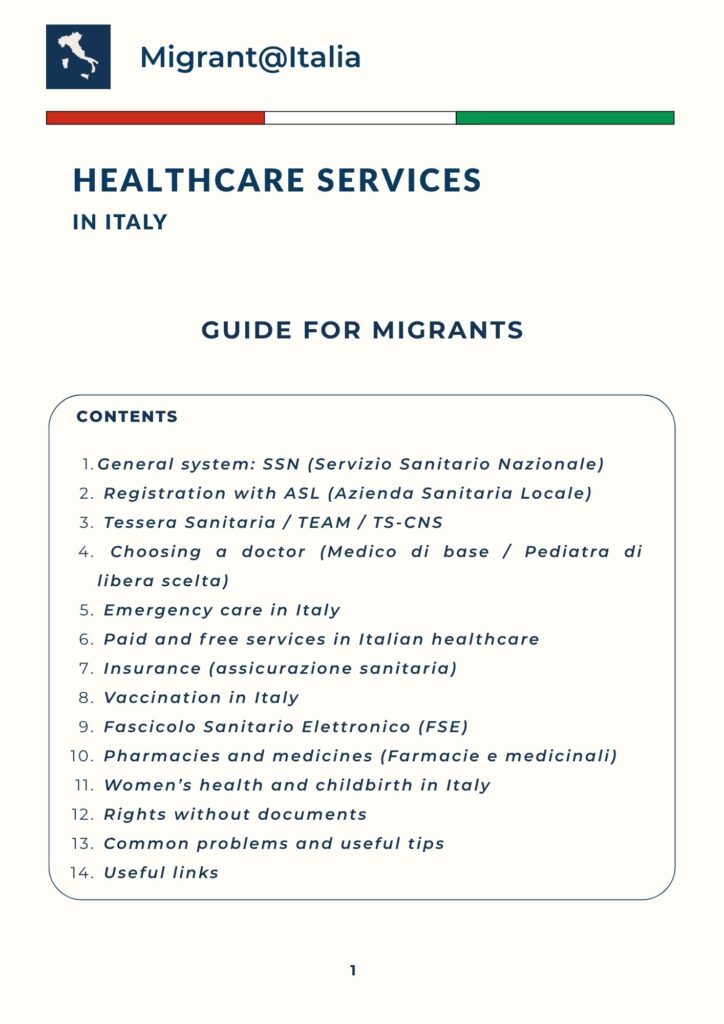
We’ve prepared a detailed PDF Guide for you about Healthcare servicesin Italy.
Download and use it as a ready-to-go manual!