
Italian Language Courses
1. Why is it important to learn Italian?
• 🏛 Integration: communication in everyday life — healthcare, school, shopping, public offices.
• 👔 Work: most employers require at least A2–B1 level.
• 📑 Documents: for obtaining the Permesso di soggiorno UE per soggiornanti di lungo periodo (A2) and Italian citizenship (B1).
• 🎓 Education: admission to universities and vocational courses.
• 🌍 Adaptation: communicating with doctors, the municipality, and neighbors.
2. Legal framework
📌 Accordo di integrazione (2012)
- This is the agreement every foreign national signs when receiving their first permesso di soggiorno valid for more than 1 year.
- It requires the foreign national to reach A2 (elementare) level in Italian during the first years of stay.
- It is verified by means of:
- a CPIA certificate (public courses),
- or a certificate from an official exam (CILS, CELI, PLIDA, CERT.IT).
If a person does not prove A2 level → further renewal of the permesso may be refused.
📌 Testo Unico Immigrazione (D.Lgs. 286/1998)
- Article 38 guarantees the right of access to Italian language courses for all foreign nationals, even without residenza.
- This means CPIA courses are free of charge, and many comuni and regions also finance additional language programs.
📌 CPIA (Centri Provinciali per l’Istruzione degli Adulti)
- Public adult-education schools operating in every region.
- Upon completion of courses, you can obtain an Attestato di conoscenza lingua italiana (A2), officially recognized:
- for the permesso di soggiorno UE lungo periodo;
- for the Accordo di integrazione.
- Important: a CPIA certificate is a free alternative to paid international exams.
📌 Permesso di soggiorno UE per soggiornanti di lungo periodo
- To obtain this document you must prove A2 level.
- Accepted:
- a CPIA certificate,
- a CILS A2, CELI A2, PLIDA A2, or CERT.IT A2 certificate.
If you do not have such a document → you must take an exam at the prefettura.
📌 Italian citizenship (Legge 132/2018)
- Since 2018, confirming language knowledge at the B1 cittadinanza level (CEFR standard) is a mandatory requirement.
- Accepted documents:
- CILS B1, CELI B1, PLIDA B1, CERT.IT B1 certificates,
- or diplomas/certificates obtained in Italy (for example, scuola media superiore or university).
- Not accepted: certificates from Duolingo or private courses without accreditation.
📌 Summary — where and which level is required
Renewal of the permesso di soggiorno (Accordo di integrazione) → A2 level.
Permesso UE lungo periodo → A2 level (CPIA is sufficient).
Citizenship → B1 level (only international certificates or diplomas from Italian schools/universities).
Work/university → usually B2 and above (set separately by the employer or institution).
🎓 3. Types of Italian language courses
In Italy there are several main training formats. It is important to understand which courses are suitable for integration and daily life, and which are officially recognized for documents (permesso, citizenship, studies).
🏫 1) CPIA (Centri Provinciali per l’Istruzione degli Adulti)
These are public adult schools set up by the Italian Ministry of Education.
📌 Features:
- Completely free (state-funded).
- Available in every province.
- Courses from A1 to B2.
- Upon completion they issue an Attestato di conoscenza della lingua italiana — a document that:
– is accepted for the Accordo di integrazione (A2),
– is recognized when applying for the Permesso UE lungo periodo,
– is suitable to prove your level when obtaining residenza.
📌 What CPIA does NOT certify:
- Citizenship (you need a B1 certificate from international centers).
🤝 2) Courses run by associations, churches, and volunteers
Organized by Caritas, ARCI, AUSER, ACLI, Patronato, the Red Cross, and municipalities.
📌 Features:
- Mostly A1–A2 levels.
- Aimed at newcomers.
- Informal atmosphere, taught by volunteers or retired teachers.
- Often free, sometimes a symbolic fee (€5–20 for textbooks).
- Classes often in the evening — convenient for workers.
📌 Certificates:
- NOT officially recognized (for permesso or cittadinanza).
- But they provide good spoken-language practice.
🌐 3) Online courses
📌 Official and public:
- italiano.rai.it — a public broadcaster platform with interactive exercises and videos.
- Eduopen (free university courses).
📌 Popular private:
- Duolingo, One World Italiano, Loescher Edizioni, Babbel, Busuu.
- YouTube: Learn Italian with Lucrezia, ItalianPod101, Vaporetto Italiano.
📌 Certificates:
- Online-course certificates are NOT officially recognized for documents.
- They can only be used as a supplementary tool.
- but its certificates are not official either.
🎓 4) Courses with official international certificates
This is the most important block, because these certificates are required for citizenship and international recognition.
- CILS (Certificazione di Italiano come Lingua Straniera) – Università per Stranieri di Siena.
- CELI (Certificato di Conoscenza della Lingua Italiana) – Università per Stranieri di Perugia.
- PLIDA (Progetto Lingua Italiana Dante Alighieri) – Società Dante Alighieri.
- CERT.IT – Università Roma Tre.
📌 Particulars:
- Certificates are recognized by the Ministero dell’Interno and accepted for citizenship (B1) and for universities (B2–C1).
- Exams are paid (€100–160).
- Organized several times per year.
4. Certificates (officially recognized)
CILS (Università per Stranieri di Siena).
CELI (Università per Stranieri di Perugia).
PLIDA (Società Dante Alighieri).
CERT.IT (Università Roma Tre).
📌 Used for citizenship, permesso lungo periodo, study, and work.
💶 Exam cost: approximately €100–160.
🔎 5. How to find courses in your city
Depending on your city and region, there are several ways to enroll. It’s important to know exactly where to go.
🏛 Comune (town hall, Ufficio Stranieri / Sportello Immigrazione)
- In large cities there are Sportelli Immigrazione with lists of available courses and contacts.
- They direct you to CPIA, associations, or municipal courses.
- The Comune often funds its own language programs for newcomers.
🏫 CPIA (Centri Provinciali per l’Istruzione degli Adulti)
- The main official route for free courses.
- You can enroll:
- via an online form on your regional CPIA website,
- in person at the school office (codice fiscale, ID, and permesso/ricevuta are often required).
- In large cities there are sometimes waiting lists, so it’s better to sign up in advance (September–October for the new school year).
🤝 Patronato, Caritas, trade unions
- Patronato (INCA, INAS, ACLI, CISL, UIL) — in addition to help with paperwork, they often have their own courses or refer you to Caritas.
- Caritas — one of the most popular organizations, especially for newcomers who do not yet have a permesso.
- Trade unions (CGIL, CISL, UIL) — in some regions organize language courses for workers.
📚 Libraries, schools, church organizations
- Many municipal libraries have “conversation clubs” (gruppi di conversazione).
- Some schools run evening adult courses after hours.
- Catholic parishes, Protestant communities, and Islamic cultural centers also often offer lessons.
🌐 Online groups and social media
- Facebook groups of migrants in a specific city are one of the quickest ways to learn about courses.
- In Telegram channels, migrants share links to volunteer courses and discuss course quality.
- Social media often helps people find free online conversation groups.
📊 6. CEFR levels (Common European Framework of Reference for Languages)
CEFR is the international system for assessing language proficiency. In Italy it is used for all official certificates and for requirements for foreign nationals.
🔹 A1 – Beginner level (principiante)
- Knowledge of only basic words and simple phrases.
- Examples: “Ciao, mi chiamo …”, “Vorrei un caffè.”
- Used for initial everyday orientation.
- Officially not required for documents, but it is the foundation for further learning.
🔹 A2 – Elementary level (elementare)
- You can hold a simple dialogue in a shop, on transport, at the doctor’s.
- Required for:
– fulfilling the Accordo di integrazione;
– obtaining the Permesso UE per soggiornanti di lungo periodo. - Proven by a CPIA certificate or international exams (CILS, CELI, PLIDA, CERT.IT).
🔹 B1 – Intermediate level (intermedio)
- You can describe events, express opinions, and understand uncomplicated texts.
- Required for:
– obtaining Italian citizenship (cittadinanza per residenza or by marriage). - Proven only by international exams (CILS B1 cittadinanza, CELI, PLIDA, CERT.IT).
⚠️ CPIA certificates at this level are not valid for citizenship.
🔹 B2 – Upper-intermediate (avanzato)
- More fluent use of the language: understanding news, professional texts, discussions.
- Required for:
– admission to Italian universities (most faculties);
– work in many professional fields. - B2 certificates are recognized for both study and work.
🔹 C1–C2 – Advanced (avanzato/superiore)
- C1 — near-fluent proficiency for academic or professional purposes.
- C2 — native-like level.
- Used:
– for teaching in Italian schools/universities;
– for work in law, medicine, and public administration.
🏛 7. Government support
Italy recognizes language learning as a key element of migrant integration, therefore there are special programs:
🔹 Integration courses (Accordo di integrazione)
- Newcomers sign the agreement at the questura when obtaining a permesso.
- It provides for learning Italian up to A2 level.
- Courses are state-funded and organized by CPIA.
🔹 Attestato di conoscenza della lingua italiana
- This is the official certificate issued by CPIA after completing the course.
- It is recognized:
– when renewing the permesso,
– for the permesso UE lungo periodo. - Advantage: it is free, unlike international exams.
🔹 Programs for vulnerable groups
- Some regions (for example, Emilia-Romagna, Lombardia, Lazio) organize free courses for women with children, older adults, and migrants without a permesso.
- An important nuance: even without documents you can attend courses by obtaining an STP/ENI code.
8. Practical tips
🟢 Start with CPIA
- This is the only free and officially recognized way to obtain an A2-level certificate.
- It’s important to enroll in September–October (start of the school year), because mid-year places may be unavailable.
📚 Use libraries
- Municipal libraries often have “conversation clubs” (gruppi di conversazione).
- You can practice the language there for free, even if you are not yet attending official courses.
🗣 Tandem partners (scambio linguistico)
- A format where an Italian learns your language and you learn Italian.
- Where to look: Facebook groups (Tandem linguistico + city), websites (ConversationExchange.com, Tandem.net).
📱 Apps for daily practice
- Reverso, WordReference — for translations and sentence examples.
- Memrise, Anki — flashcards for memorizing words.
- RAI Play, RAI Scuola — videos in Italian with subtitles.
📝 Keep a journal in Italian
- Even 2–3 sentences a day help systematize knowledge.
- Combine with language tandem: you write a text, your partner corrects it.
🔗 9. Useful links
• CPIA – Centri Provinciali per l’Istruzione degli Adulti
In every major city, for example:
https://cpiaudine.edu.it/ (Udine)
https://www.cpiaparma.edu.it/ (Parma)
https://www.cpiavenezia.edu.it/ (Venezia)
and others
• Ministero dell’Istruzione e del Merito (MIUR)
www.miur.gov.it — information on educational programs and courses for foreign nationals.
• Ministero dell’Interno – Cittadinanza
www.interno.gov.it — conditions for obtaining citizenship, including language requirements.
• Società Dante Alighieri (PLIDA)
www.plida.it — exams and courses for the PLIDA certificate.
• Università per Stranieri di Siena (CILS)
www.unistrasi.it — official page for the CILS certificate.
• Università per Stranieri di Perugia (CELI)
www.cvcl.unipg.it — CELI exams.
• Università Roma Tre (CERT.IT)
www.cert-italiano.it — CERT.IT certification.
• italiano.rai.it — free platform with interactive lessons and exercises.
Frequently Asked Questions (FAQ)
Can I attend courses without a permesso di soggiorno?
👉 Yes. Many organizations (Caritas, Patronato, associations) accept people even without documents, with STP/ENI. CPIA usually requires a permesso or ricevuta.
Are the courses free?
👉 Yes. CPIA and courses run by Caritas or associations are completely free. Private schools are paid (200–600€ per course).
What language level is needed for the permesso UE lungo periodo?
👉 A2 level, confirmed by a CPIA certificate or an international exam.
What level is required for citizenship?
👉 At least B1. The certificate must be from accredited centers (CILS, CELI, PLIDA, CERT.IT). CPIA is not suitable.
Are certificates from online courses (Duolingo, Babbel, Loescher) recognized?
👉 No. They are useful for learning but are not officially accepted.
What is CPIA and are its certificates recognized?
👉 CPIA are public adult-education schools. Their certificates are recognized for A2 (permesso UE lungo periodo, Accordo di integrazione), but not for citizenship.
Can I take the B1 exam without courses?
👉 Yes, if you have studied independently. You can register for the exam at an accredited center (CILS, CELI, PLIDA, CERT.IT).
How do I find courses in a small town?
👉 Contact the Comune or the library. If there is no CPIA in your town, they will refer you to the nearest province.
Are there courses for women with children?
👉 Yes. Many regions run programs for mothers with young children. Caritas and municipalities sometimes offer courses with childcare rooms.
Can language knowledge be certified with a diploma?
👉 Yes. If you completed an Italian scuola media, liceo, or university — this automatically certifies your language knowledge and no additional certificate is needed.
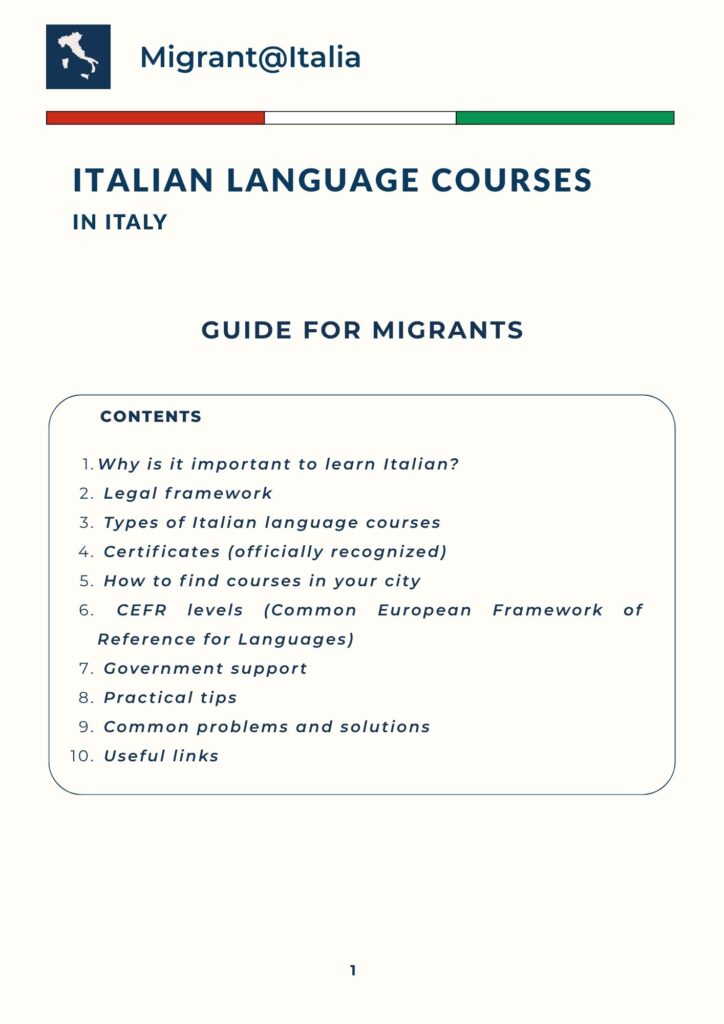
We’ve prepared a detailed PDF Guide for you about Italian Language Courses.
Download and use it as a ready-to-go manual!