
PERMESSO DI SOGGIORNO
per protezione temporanea emergenza Ucraina
Permesso di soggiorno per protezione temporanea emergenza Ucraina is a special residence permit introduced in 2022 in response to the war in Ukraine.
⚖️ 1. Legal framework
- EU Directive 2001/55/EC (20 July 2001) — minimum standards for temporary protection in mass influx situations;
- Council Implementing Decision (EU) 2022/382 of 4 March 2022 — activated temporary protection for persons displaced from Ukraine;
- Legge 26/2026 (Italy, 27 February 2026) — extended Italian temporary protection to 4 March 2027, aligning with the EU decision.
Current Status
| Level | Valid until |
| EU (Council Decision) | 4 March 2027 |
| Italy (Legge 26/2026) | 4 March 2027 |
⚠️ CRITICAL — Updated: The previous Italian deadline of 31 March 2026 (D.L. 202/2024) has been superseded by Legge 26/2026, which extends Italian temporary protection to 4 March 2027, in line with the EU extension.
2. Who can apply
Category A: Ukrainian citizens who lived in Ukraine before 24.02.2022 and were displaced on or after that date.
Category B: Stateless persons and third-country nationals who held international or national protection in Ukraine before 24.02.2022.
Category C: Third-country nationals with a permanent residence permit in Ukraine before 24.02.2022 who cannot safely return to their country of origin.
Family members of categories A, B, C: spouse/stable partner; unmarried minor children; dependent parents/adult children who lived in the same household.
Who is NOT covered
- Students, workers, and other third-country nationals who lived in Ukraine temporarily (without refugee/national protection status and without a permanent Ukrainian residence permit);
- Persons who arrived in Italy before 24.02.2022.
Documents commonly requested as proof
- Identity: international passport, national ID, or other identity document; for category B — proof of protection status in Ukraine; for category C — proof of permanent residence in Ukraine;
- Proof of residence in Ukraine before 24.02.2022 and displacement after that date (stamps, tickets, indirect evidence);
- Proof of family ties (marriage/birth certificates, evidence of cohabitation and dependency).
⚙️ 3. Step-by-step actions
Official procedure
1) Arrival in Italy
- Temporary protection does not require a visa. Ukrainian citizens can enter with a biometric passport; a regular international passport or a national ID + entry stamp is also accepted.
- You are not obliged to file a dichiarazione di presenza at the border or immediately afterwards—this is covered once you apply for the Permesso.
2) Apply at the Questura
- File an application for a permesso di soggiorno per protezione temporanea at the immigration office of the Questura where you live.
- Booking at the Questura:
- In most cities there is no online booking—service is first come, first served.
- In some, phone/online pre-booking is required (check your Questura’s website).
3) Prepare and submit documents
- Passport (international or Ukrainian national).
- Passport-format photos.
- Documents proving you fall under temporary protection (see Who can apply).
- Declaration of address (ospitalità or autocertificazione di residenza).
4) At the Questura
- Fingerprints.
- Photo capture.
- Check and copy of all documents.
- Issue of the ricevuta — official proof your application has been accepted.
5) Using the ricevuta
From the moment you have the ricevuta, you may:
- work (as an employee or with a Partita IVA);
- register with the health service (SSN);
- open a bank account;
- enrol in free Italian language courses.
The ricevuta is valid until you receive the plastic card.
6) Waiting and card collection
- Timeframes vary by city: from 2–3 weeks to several months.
- Check readiness:
- on Portale Immigrazione;
- via SMS from the Questura;
- by visiting the Questura.
7) Renewals
- When the EU/Italy extend protection, the Questura publishes instructions.
- In 2025 and in 2026, automatic renewals were replaced by a new application with fees (details below).
Receiving the Italian Permesso after (or while holding) temporary protection in another EU country
🏛 Official position (EU & Italy)
- Directive 2001/55/EC allows Ukrainian nationals to obtain protection in one EU country of their choice.
- You cannot hold active temporary protection in two countries simultaneously.
- When moving to another country:
- Deregister and end your status in the first country;
- Apply in the new country within the set deadlines (in Italy — at the Questura).
🇮🇹 Italian requirements
The Questura will require:
- Passport (international or national).
- Proof you ended temporary protection in the first country: a certificate/letter from that country’s authority confirming termination.
- Proof of residence in Italy (ospitalità or a lease).
If you have no proof of termination, the Questura will often:
- refuse to accept the application; or
- ask you to wait until the first status expires.
4. Required documents
1) Basic set for first-time application in Italy
dichiarazione di ospitalità (host’s statement with a copy of their ID and lease/title deed); or
Valid passport (international or national) + copies of all completed pages.
If no international passport: submit the national ID; for children, a birth certificate. Ukrainian consulates in Italy can issue temporary IDs (up to six months) for those who arrived without documents.
Four passport-size photos (35×40 mm, white background).
Codice Fiscale — if you don’t have one, it is usually issued alongside the application.
Proof of residence in Italy:
- dichiarazione di ospitalità (host’s statement with a copy of their ID and lease/title deed);
- a lease contract.
2) Additionally, if moving from another EU country where you had temporary protection
(required for the Italian Questura to accept the case)
- Official document confirming termination of temporary protection in the first country.
- Italian translation (preferably certified; some Questure ask for an apostille).
- If available: a copy of the previous temporary protection card/letter.
- If moving with children — separate termination documents for each child.
- Where necessary — the other parent’s consent for the child’s move.
5. Validity periods
Italy: until 4 March 2027 (Legge 26/2026, issued 27 February 2026).
The physical card is always aligned with the latest national extension decree/law.
Renewals
Official procedure
| Step | Details |
| When to apply | 60 days before expiry |
| Where | Questura (in-person, or by PEC in some regions) |
| Documents | Current card/ricevuta; 4 passport photos; proof of address |
| Fees | Marca da bollo €16.00 + card fee €30.46 = €46.46 |
| Processing | 2–4 weeks (Questura notifies by SMS/letter) |
6. Costs
| Situation | Cost |
| First application | FREE — no marca da bollo, no card fee |
| Renewal | €16.00 (marca) + €30.46 (card) = €46.46 |
| Replacement (loss/damage) | €16.00 (marca) + €30.46 (card) = €46.46 + denuncia |
Temporary protection remains cheaper than standard permessi (work, family: ≈€192–202).
Replacement procedure
If lost/stolen: file denuncia at Questura or Carabinieri → bring denuncia + passport + 4 photos + CF + proof of address + €16 + €30.46.
If damaged: bring damaged card to Questura — same procedure as loss (no denuncia required).
If personal data changed: provide proof of change (translated/apostilled if required) + same steps as reissue.
7. Healthcare — Codice X22
📌 Important for Ukrainian nationals: Those not working and not enrolled in SSN through employment access healthcare in Italy via Codice X22 (a specific health registration code for temporary protection holders). This code is valid until 31 December 2026 (Circolare Ministero della Salute prot. 0002292/2026).
Ukrainian citizens with active employment access SSN through their employer in the normal way (registration at ASL as workers).
8. Rights under Italian law and Directive 2001/55/EC
🏠 Right to reside
- Lawful stay in Italy for the entire duration of temporary protection.
- Free movement within Italy.
- Short-term travel to other EU countries (up to 90/180 days) if you have a Ukrainian biometric passport and a valid Permesso.
💼 Right to work
- Work is allowed from day one — no separate permesso per lavoro required.
- Employment or self-employment permitted (including opening a Partita IVA).
- You may register with the centro per l’impiego.
- All contract types are permitted: indeterminato, determinato, stagionale, etc.
📚 Right to education
- Children have access to free compulsory schooling on equal terms with Italian citizens.
- Access to all levels of education, including universities (sometimes with simplified entry rules).
- Free or subsidized Italian courses (including via CPIA).
🏥 Right to healthcare
- Registration with the Servizio Sanitario Nazionale (SSN).
- Free choice of family doctor (medico di base) and paediatrician.
- Free or subsidized healthcare on conditions similar to Italian citizens.
- Free access to emergency care.
💶 Social rights
- Eligibility for certain benefits (e.g., assegno unico per figli, means-tested support) subject to residence requirements.
- In some regions: additional support (free transport passes, food cards).
🚗 Driving rights
- You may use your Ukrainian driving licence throughout the period of temporary protection (formally until the licence’s expiry in Ukraine).
- Exchange to an Italian licence is possible without a driving test.
On request, we can provide separate advice on exchanging a Ukrainian licence for an Italian one.
📄 Other rights
- Opening bank accounts.
- Opening a Partita IVA and carrying out business activities.
- Signing contracts for phone, Internet, utilities.
Renting accommodation in your own name.
9. Main refusal grounds & common mistakes
Official grounds for refusal or revocation
(under Directive 2001/55/EC and Italian law — D.Lgs. 85/2003 and subsequent decrees/circulars):
- No grounds for temporary protection
The person is not in the listed categories (e.g., was not in Ukraine at the relevant time, is not a refugee/family member, arrived in Italy before 24.02.2022). - Public-security risk
Convictions for serious crimes in Italy or another EU country; links to terrorist/criminal organisations. - Protection already granted in another country
Holding temporary protection in another EU Member State and applying in Italy without terminating the first status (protection must be in one state). - False information/forged documents
Fake passports, sham family certificates; mismatched personal data. - Voluntary departure from Italy to live elsewhere.
- Moving to another country and obtaining protection or a residence permit there.
Common applicant mistakes (practice) & how to avoid them
- No termination proof from the first country (Poland, Germany, Czechia, etc.) → Questura refuses.
Solution: secure written confirmation beforehand. - Applying without an international passport. In 2022 internal IDs were often accepted; in 2024–2025 most Questure require a biometric passport or proof it has been requested (regional exceptions apply).
- No proof of address (residenza or dichiarazione di ospitalità). Even if not strictly required by law, many Questure ask for it.
- Late renewal. Missing the renewal window sometimes forces a fresh start, complicating your legal position.
- Missing translations. Some Questure require Italian translations (especially marriage/birth certificates). Bringing originals without translations often leads to postponed appointments.
10. Conversion from/to other Permesso
From other permits to protezione temporanea
❌ Not possible. Temporary protection is an exceptional regime granted only to those meeting specific criteria (nationality, dates, status).
From protezione temporanea to other permits
✅ Possible at any time before expiry:
| Target permit | Conditions |
| Lavoro subordinato | Signed employment contract |
| Lavoro autonomo / Partita IVA | Registered Partita IVA + active activity |
| Motivi familiari | Qualifying family relationship with Italian/EU/legal resident |
| Studio / formazione | Enrolment in qualifying course |
⚠️ Time under temporary protection does NOT count towards the 5 years required for the Permesso UE per soggiornanti di lungo periodo. After conversion, the qualifying residence clock starts from the date of the new permit type.
⚠️ If officers say conversion is impossible, ask them to refer to the Ministero dell’Interno circulars (14.03.2022 and subsequent updates).
🧠 11. Tips & important information
1. Plan your long-term path early. Protezione temporanea has an end date (Italy: 4 March 2027). If you plan to stay, convert to a qualifying permit (lavoro, famiglia) as soon as possible — conversion is easier while your protezione temporanea is still valid.
2. Time under protezione temporanea does NOT count towards the Permesso UE per soggiornanti di lungo periodo.
3. Questura queues in large cities (Milan, Rome, Naples) are long — book early.
4. First application is free — no marca da bollo, no card fee.
5. Renewals (2025–2026): €16 + €30.46 = €46.46.
6. Healthcare code X22 — valid until 31.12.2026 for non-workers; update your SSN registration through your ASL.
7. Work rights start from the ricevuta — do not wait for the plastic card.
8. Moving from another EU country: Italy requires official proof that the previous status was terminated.
9. Driving: Ukrainian licence valid during protezione temporanea; exchange to Italian licence is possible without a driving test.
Корисні посилання:
12. Useful links:
⚖️ Government and EU references
- Ministero dell’Interno (Italian Ministry of the Interior) — section on temporary protection
- European Commission — official page on temporary protection within the EU
- Gazzetta Ufficiale — publication of Italian decrees and laws extending temporary protection
https://www.gazzettaufficiale.it
📨 Application and renewal procedure
- Portale Immigrazione — official Italian Immigration Portal for tracking the status of your Permesso di soggiorno
https://www.portaleimmigrazione.it
- Poste Italiane — information about Sportello Amico branches that handle Permesso application kits
- Questure Polizia di Stato — find your local Questura’s address and contact information
https://questure.poliziadistato.it
🏥 Healthcare and medical assistance
- Servizio Sanitario Nazionale (SSN) — official information about healthcare rights for people under temporary protection
Frequently Asked Questions (FAQ)
1. How long does temporary protection in Italy last? Currently until 4 March 2027 — extended by both the EU (Council Decision) and Italy (Legge 26/2026, 27 February 2026).
2. Can I come from another EU country where I had temporary protection? Yes, but you must first officially terminate that status. Without proof of termination, the Questura may refuse to accept your application.
3. Do I need to file a dichiarazione di presenza? No — for Ukrainians under temporary protection, the application for the permesso itself fulfils this requirement.
4. Can I work? Yes — from the date on the ricevuta. Both employment (lavoro subordinato) and self-employment (Partita IVA) are permitted.
5. What documents are needed for the first application? International passport (or national ID in exceptional cases); 4 photos; Codice Fiscale (if held); proof of accommodation; proof of eligibility. If transferring from another EU country — termination document.
6. Is a marca da bollo required? No — for the first application. For renewals: €16 (marca) + €30.46 (card fee) = €46.46.
7. Can this permesso be converted to a work or family permit? Yes — at any time before expiry, provided you meet the conditions (work contract, Partita IVA, family relationship).
8. Can I travel abroad? Yes — to EU/Schengen countries (up to 90 days per 180-day period) and to Ukraine. For non-EU countries, check visa rules.
9. What if my permesso is lost or stolen? File a denuncia immediately at Questura/Carabinieri. Then go to the Questura with: denuncia, passport, 4 photos, CF, proof of address, €16 + €30.46.
10. Does this permesso count towards the EU long-stay permit? No. Time under temporary protection does not count towards the 5 years required for the Permesso UE per soggiornanti di lungo periodo.
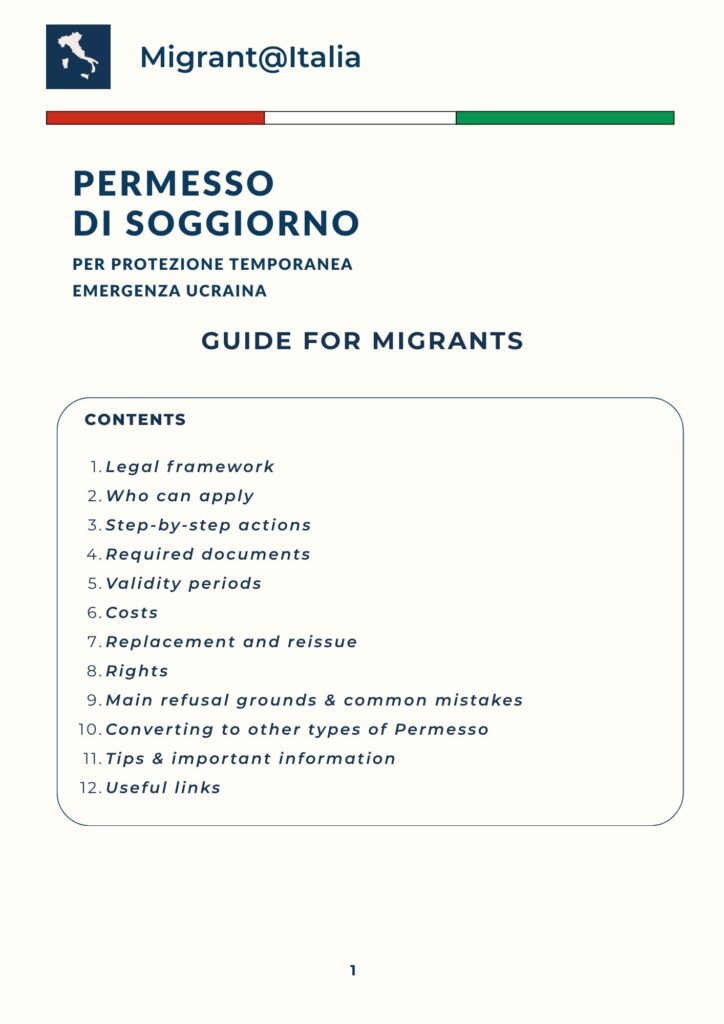
We have prepared for you a detailed PDF Guide: it includes all the steps and procedures for obtaining the Permesso di soggiorno per protezione temporanea emergenza Ucraina
Download and use it as a ready-to-go manual!